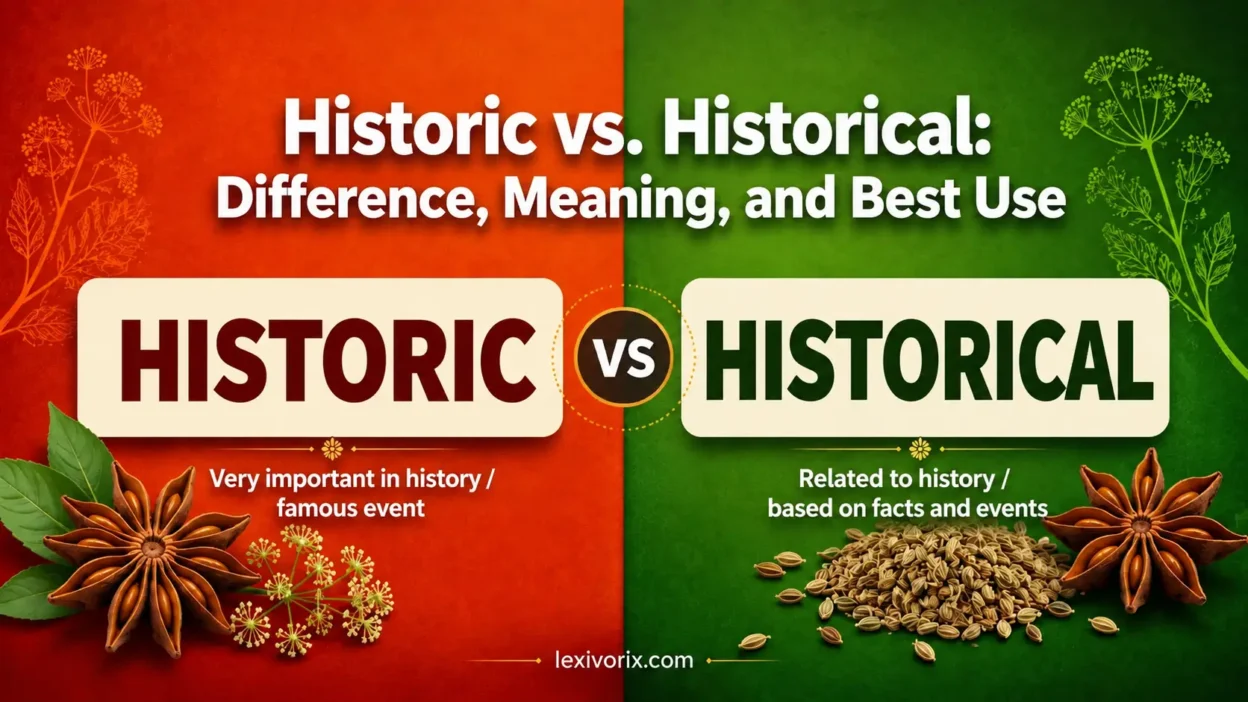
Navigating the nuances of English grammar can feel confusing, especially when choosing between historic vs. historical. Both words are adjectives rooted in the same Latin and Greek origins, both describe past events, and both sound almost identical in conversation. However, using historic vs. historical interchangeably can alter the exact meaning of your sentence.
When writers compare historic vs. historical, the key distinction lies in importance versus origin. If an event alters human destiny or carries major cultural weight, it is historic. If something simply existed in an earlier time period or relates to the academic study of history, it is historical. Understanding historic vs. historical ensures your professional, academic, and creative writing remains precise, polished, and impactful.
Quick Answer
To master historic vs. historical, remember this simple rule:
- Historic: Refers to famous, groundbreaking, or momentous occurrences that make history.
- Historical: Refers to anything related to the past, history research, or earlier eras, regardless of how important it was.
Historic: "The leaders signed a historic treaty ending decades of conflict."
Historical: "The researcher spent months analyzing historical records in the city library."
In the debate over historic vs. historical, everything that is historic is also historical because it occurred in the past. However, very few historical items qualify as historic because most daily occurrences from the past do not change world history.
Why People Confuse Historic vs. Historical
People frequently mix up historic vs. historical for three primary reasons:
- Shared Etymology: Both words stem directly from the noun history.
- Overlapping Contexts: Museums, schools, textbooks, and news broadcasts regularly feature both historic vs. historical terminology side by side.
- Dual Applications: A single landmark can trigger both historic vs. historical designations. A structure can be a historical building simply because it was constructed in 1850, but it becomes a historic site if a famous declaration was signed inside its walls.
Recognizing these overlaps helps prevent common errors when choosing between historic vs. historical.
Key Differences At A Glance
The breakdown below clarifies when to choose historic vs. historical across standard writing scenarios:
| Context | Best Choice | Primary Reason |
|---|---|---|
| A Moon Landing Mission | Historic | Represents a groundbreaking human achievement. |
| Old Financial Ledgers | Historical | Relates to past financial records without world-changing impact. |
| Period Drama Films | Historical | Set in a bygone era or based on past times. |
| A Global Peace Accord | Historic | Alters future geopolitical relations. |
| University Archives | Historical | Preserves general historical artifacts and research materials. |
Compact Breakdown of Historic vs. Historical
- Use historic when emphasizing impact, fame, and historical significance.
- Use historical when emphasizing time, chronology, and connection to the past.
Meaning and Usage Difference
Deep Dive into Historic
The adjective historic highlights monumental significance. When you label an event as historic, you are saying it stands out in the timeline of human history.
- Historic Elections: An election where a country votes in a groundbreaking new political system.
- Historic Discoveries: The discovery of penicillin or the mastery of flight.
- Historic Decisions: Landmark court rulings that establish new civil rights.
Deep Dive into Historical
The adjective historical takes a neutral, descriptive tone. It does not judge how important an item was; it merely confirms its association with past times.
- Historical Fiction: Stories set in past periods, such as the Renaissance or Colonial America.
- Historical Data: Weather statistics collected over the past century to study global climate shifts.
- Historical Documents: Everyday letters, receipts, or legal contracts written long ago.
Pronunciation and Article Usage: “A” vs. “An” Historic
A frequent debate within historic vs. historical discussions is whether to write a historic or an historic.
In modern American English, both historic and historical begin with a hard, voiced /h/ sound. Therefore, standard grammar rules dictate using a:
- Correct (US Standard): A historic victory | A historical document
- Less Common (Traditional/UK): An historic victory | An historical document
While “an historic” stems from older dialects where the initial “h” was silent (similar to an hour), modern American usage overwhelmingly favors a historic and a historical.
Tone, Context, and Formality
Choosing between historic vs. historical affects the tone of your text across different media:
Journalism and Media
Reporters reserve historic for pivotal moments, such as a historic economic crisis or a historic vote. Overusing historic for routine political speeches can cause sensationalism, making historical context a better fit.
Academia and Research
Professors, researchers, and historians favor historical. They evaluate historical methodology, historical trends, and historical artifacts. Calling everyday archive findings “historic” can sound exaggerated in formal papers.
Legal and Commercial Sectors
Lawyers review historical precedents (past cases) to argue a historic ruling (a new, ground-breaking decision). Businesses examine historical quarterly revenue to predict future growth.
Which One Should You Use?
When debating historic vs. historical in your drafting, apply this basic rule:
Ask: Does this make history, or does it simply belong to history?
- If it made history or broke a major barrier, choose historic.
- If it refers to past eras, data, or research, choose historical.
Quick Decision Tree for Historic vs. Historical
- Are you describing a record-breaking athletic achievement? $\rightarrow$ Historic
- Are you writing a paper on 18th-century trade routes? $\rightarrow$ Historical
- Are you discussing a novel set in ancient Egypt? $\rightarrow$ Historical
- Are you marking the first humans on Mars? $\rightarrow$ Historic
When One Choice Sounds Wrong
To master historic vs. historical, study these incorrect and correct sentence pairs:
- Incorrect: The archivist dusted off historic grocery lists from 1912.
- Correct: The archivist dusted off historical grocery lists from 1912.
- Reason: Everyday grocery lists belong to the past, but they are not world-altering events.
- Incorrect: Splitting the atom was a historical moment for physics.
- Correct: Splitting the atom was a historic moment for physics.
- Reason: Splitting the atom fundamentally transformed science, making it a true breakthrough.
Common Mistakes (and Quick Fixes)
Avoiding these five pitfalls will improve your precision when writing historic vs. historical:
- Using “An” Before Historic in American Business Writing
- Fix: Write “a historic day,” as the voiced “h” takes the indefinite article “a” in standard US writing.
- Calling General Vintage Items “Historic”
- Fix: Old items like vintage clothing are historical artifacts unless they played a central role in a historic moment.
- Mislabeling Literary Genres
- Fix: Always refer to “historical fiction,” never “historic fiction,” because the stories depict past periods rather than making history themselves.
- Mislabeling Analytical Datasets
- Fix: Use “historical data” or “historical records” when assessing trends over time.
- Hyperbolic Overuse of Historic
- Fix: Save “historic” for genuine milestones so the word retains its rhetorical power.
Everyday Examples
These real-world examples illustrate the correct usage of historic vs. historical:
- Business: “Our team analyzed historical performance indicators to prepare the annual budget.”
- Politics: “The diplomat called the signing of the peace accord a historic triumph for regional stability.”
- Culture: “Visitors tour the museum to admire historical costumes worn by 19th-century citizens.”
- Sports: “The athlete set a historic world record by breaking the four-minute barrier.”
- Science: “Geologists study historical earthquake patterns to improve modern safety standards.”
Dictionary-Style Word Details
Verb
- historic: Does not function as a verb.
- historical: Does not function as a verb.
Noun
- historic: Does not function as a noun.
- historical: Does not function as a noun (use history or historian).
Synonyms
- historic: Momentous, landmark, famous, ground-breaking, celebrated, consequential.
- historical: Past, archival, documented, period, chronological, ancient.
Example Sentences
- historic:
- The treaty signing marked a historic moment for both nations.
- The team enjoyed a historic championship run.
- The court delivered a historic decision regarding environmental policy.
- historical:
- She published a detailed historical study on trade routes.
- The museum preserved several rare historical manuscripts.
- He prefers reading historical biographies over modern thrillers.
Word History
- historic: Originates from Latin historicus and Greek historikos, evolving in English to denote momentous events in time.
- historical: Formed by adding the suffix -al to historic to cover general connections to past history.
Phrases Containing
- historic: historic moment, historic site, historic event, historic victory, historic decision.
- historical: historical context, historical data, historical fiction, historical accuracy, historical records.
Frequently Asked Questions
The main difference between historic vs. historical is that historic describes something famous, momentous, or influential that makes history, while historical describes anything that occurred in the past or relates to the study of history.
In modern American English, write a historic event. Because the initial “h” in historic is voiced, the standard indefinite article is “a” rather than “an”.
Yes. A structure is historical simply because it was built long ago. It becomes a historic building if something momentous occurred there, such as the signing of a constitution or a major battle.
The correct literary term is historical fiction. This genre refers to novels set during real past periods rather than books that change history themselves.
Writing “an historical” is an older grammatical tradition stemming from dialects where the initial “h” was silent. While still seen in older British texts, standard American English favors “a historical”.
Remember that historic ends in “-ic,” like iconic. If an event is iconic and memorable, use historic. If it merely happened in the past, use historical.
Conclusion
Understanding historic vs. historical comes down to evaluating impact versus chronology. Use historic whenever you describe momentous events, major milestones, or world-changing accomplishments. Reach for historical when discussing past eras, archival research, general history, or period fiction. Keeping the differences between historic vs. historical clear in your mind ensures your communication stays sharp and safe.


