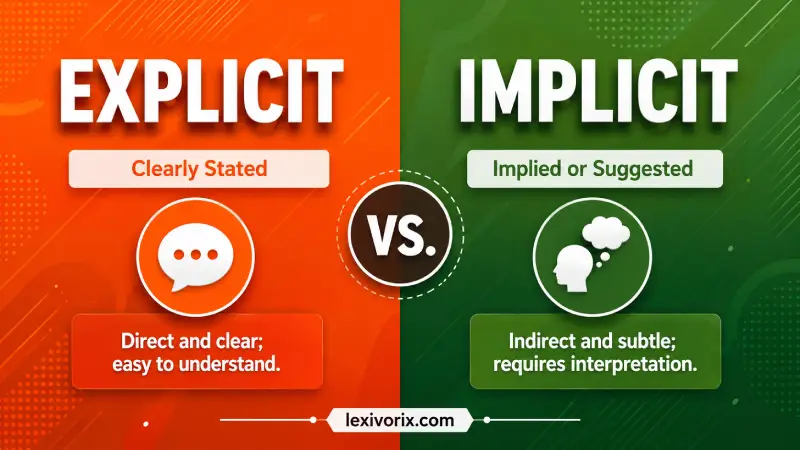
Choosing between explicit and implicit can pause even experienced writers. The two words share similar sound structures, end with the same suffix, and frequently appear in the same discussions. However, their primary meanings are exact opposites.
If you state something directly so there is no room for doubt, you are being explicit. If you suggest something or leave it to be gathered from context without saying it outright, it is implicit.
Mixing these terms up in a professional email, legal document, or academic paper distorts your intended message. Understanding how to use the explicit vs implicit distinction ensures your writing remains clear, precise, and accurate across all contexts.
Quick Answer
The difference comes down to directness:
- Explicit means clearly, directly, and plainly stated. Nothing is left to guesswork.
- Implicit means implied, suggested, or understood without being directly expressed.
Explicit: "Please turn off the lights before you leave the office at 5:00 PM."
Implicit: "We need to keep the electricity bill down this month."
These two words are not interchangeable. While they often describe the same communication scenario, they reflect opposite sides of how a message is delivered and received.
Why People Confuse Them
People frequently confuse these two words for a few distinct reasons:
- Similar Sounds and Spellings: Both words start with vowels, end in “-icit,” and share identical rhythmic patterns.
- Shared Roots: Both words derive from Latin verbs relating to folding (plicare). “Explicit” relates to unfolding or making plain, while “implicit” relates to folding in or entangling.
- Co-occurrence: They frequently appear side-by-side in discussions about contract terms, psychology studies, communication styles, and educational strategies.
Because both terms deal with how information is conveyed, it is easy to accidentally substitute one for the other if you do not focus on the prefix (ex- for out, im- for in).
Key Differences At A Glance
The following table summarizes the core practical distinctions between the two terms:
| Context | Best Choice | Why |
| Direct Work Instructions | Explicit | The tasks, deadlines, and steps are plainly set out step-by-step. |
| Unspoken Agreements | Implicit | The expectation is mutually understood through culture or context, not written down. |
| Legal Contracts | Explicit | Terms must be fully stated to prevent misinterpretation and dispute. |
| Unconscious Attitudes | Implicit | Psychological traits or biases exist beneath awareness without verbal declaration. |
| Warning Labels | Explicit | Clear safety hazard alerts must be immediately obvious and fully detailed. |
Meaning and Usage Difference
Explicit
When an idea, statement, or direction is explicit, it is spelled out in precise detail. There is no need for interpretation or reading between the lines.
In everyday communication, explicit language leaves no ambiguity. In media ratings, “explicit” carries a specialized secondary meaning referring to graphic depictions of violence, profanity, or sexual content.
- Example: The employee handbook provides explicit instructions regarding the dress code.
Implicit
When something is implicit, it exists within a situation or statement but is not directly voiced. It relies on context, shared assumptions, or logical deduction.
In psychology, an implicit bias or memory operates without conscious awareness. In economics, an implicit cost represents an opportunity cost rather than a direct financial payment.
- Example: By accepting the job offer, she gave her implicit agreement to work occasional overtime.
Tone, Context, and Formality
Neither term is inherently more formal than the other. Both appear regularly in professional, academic, legal, and everyday contexts. However, the choice of word changes the context of what you are describing.
Professional and Workplace Contexts
In management, explicit communication reduces errors by providing clear parameters. Implicit communication relies on workplace culture, established relationships, and shared norms.
Legal and Academic Contexts
Contracts favor explicit terms to ensure enforceability. However, courts also recognize implicit terms (such as an implied warranty) based on standard business practices.
Casual Writing and Conversation
In casual conversation, you might ask someone to be more explicit if their request is vague, or point out an implicit meaning behind a sarcastic comment.
Which One Should You Use?
To choose the correct word in your writing, ask yourself a single diagnostic question:
Is the message directly stated, or is it implied through context?
- If the information is stated outright, use explicit.
- If the information is suggested or understood without being stated, use implicit.
Decision Checklist
- Did someone speak or write the exact words? $\rightarrow$ Use explicit.
- Is the idea based on an assumption or context? $\rightarrow$ Use implicit.
- Are you warning someone about adult content or graphic detail? $\rightarrow$ Use explicit.
- Are you describing unspoken trust or indirect hints? $\rightarrow$ Use implicit.
When One Choice Sounds Wrong
Substituting one term for the other completely alters the sentence’s meaning or creates logical contradictions.
Incorrect vs. Correct Usage
- Incorrect: The manager gave implicit directions on how to set up the software, listing every click in detail.
- Correct: The manager gave explicit directions on how to set up the software, listing every click in detail.
- Why: Detailed, click-by-click instructions are direct and clear, making them explicit.
- Incorrect: Although nothing was written down, they had an explicit understanding of who would handle client calls.
- Correct: Although nothing was written down, they had an implicit understanding of who would handle client calls.
- Why: An unwritten, unvoiced understanding relies on context, making it implicit.
Common Mistakes (and Quick Fixes)
- Confusing “Implicit” with “Complicated”
- Mistake: “The assignment’s instructions were implicit, so I failed.”
- Fix: “The assignment’s instructions were vague, so I failed.” (Use “implicit” only when meaning is meant to be gathered from context, not just poorly explained).
- Using “Explicit” Only to Mean Graphic Content
- Mistake: Thinking “explicit instructions” implies bad language.
- Fix: Remember that in standard writing, “explicit” simply means clear and direct.
- Mixing Up Adverb Forms
- Mistake: “He implicitly stated his retirement plans during the speech.”
- Fix: “He explicitly stated his retirement plans during the speech.” (If he stated them, it was explicit).
Everyday Examples
Here are modern examples illustrating proper usage across common situations:
- Workplace Email: “I need an explicit breakdown of the budget before approving the project.”
- Team Dynamics: “There is an implicit expectation that everyone arrives five minutes early to meetings.”
- Software Design: “The user agreement requires explicit consent before collecting personal location data.”
- Customer Service: “Her tone carried an implicit frustration, even though her words remained polite.”
- Real Estate: “The property deed contains explicit boundaries defining the lot lines.”
- Education: “Teachers provide explicit phonics instruction to help young students decode words clearly.”
Dictionary-Style Word Details
Verb
- explicit: Does not function as a verb. (The related verb form is explicate).
- implicit: Does not function as a verb.
Noun
- explicit: Rarely functions as a noun, except occasionally in informal plural form (explicits) regarding content ratings.
- implicit: Does not function as a noun.
Synonyms
- explicit: Direct, clear, specific, precise, unambiguous, express.
- implicit: Implied, unstated, unspoken, indirect, tacit, understood.
Example Sentences
- explicit:
- The contract includes explicit conditions for early termination.
- She gave explicit permission for the photos to be published online.
- The sign posted at the gate gave an explicit warning against trespassing.
- implicit:
- They had an implicit agreement never to bring up the subject again.
- The movie contains an implicit critique of modern consumer culture.
- Trust is an implicit requirement for any successful partnership.
Word History
- explicit: Originates from Latin explicitus (unfolded, declared), from explicare (“to unfold” or “disentangle”).
- implicit: Originates from Latin implicitus (entangled, involved), from implicare (“to fold in” or “entangle”).
Phrases Containing
- explicit: explicit instructions, explicit consent, explicit language, explicit details.
- implicit: implicit trust, implicit agreement, implicit bias, implicit knowledge.
Frequently Asked Questions
Yes. In primary usage, they function as exact antonyms. Explicit refers to directly stated facts, while implicit refers to indirect or unstated assumptions.
Explicit means directly and clearly stated, leaving no room for confusion or interpretation.
A overall piece of communication can contain both explicit and implicit messages, but a single specific detail cannot be both at once. For example, a contract might have explicit pay terms alongside implicit workplace norms.
Yes. Implicit information always relies on context, shared understanding, or inference rather than direct statement.
While “explicit language” often refers to profanity or graphic speech in media ratings, in broader English usage, it simply means language that is plain, clear, and direct.
An implicit assumption is an unstated belief or expectation that guides behavior or reasoning without ever being spoken out loud.
Conclusion
Understanding the difference between explicit vs implicit comes down to whether information is expressed directly or left to context. Use explicit when ideas are fully, clearly, and directly stated. Use implicit when ideas are implied, unstated, or understood without direct expression. Keeping this single rule in mind will make your communication clear and accurate every time.


