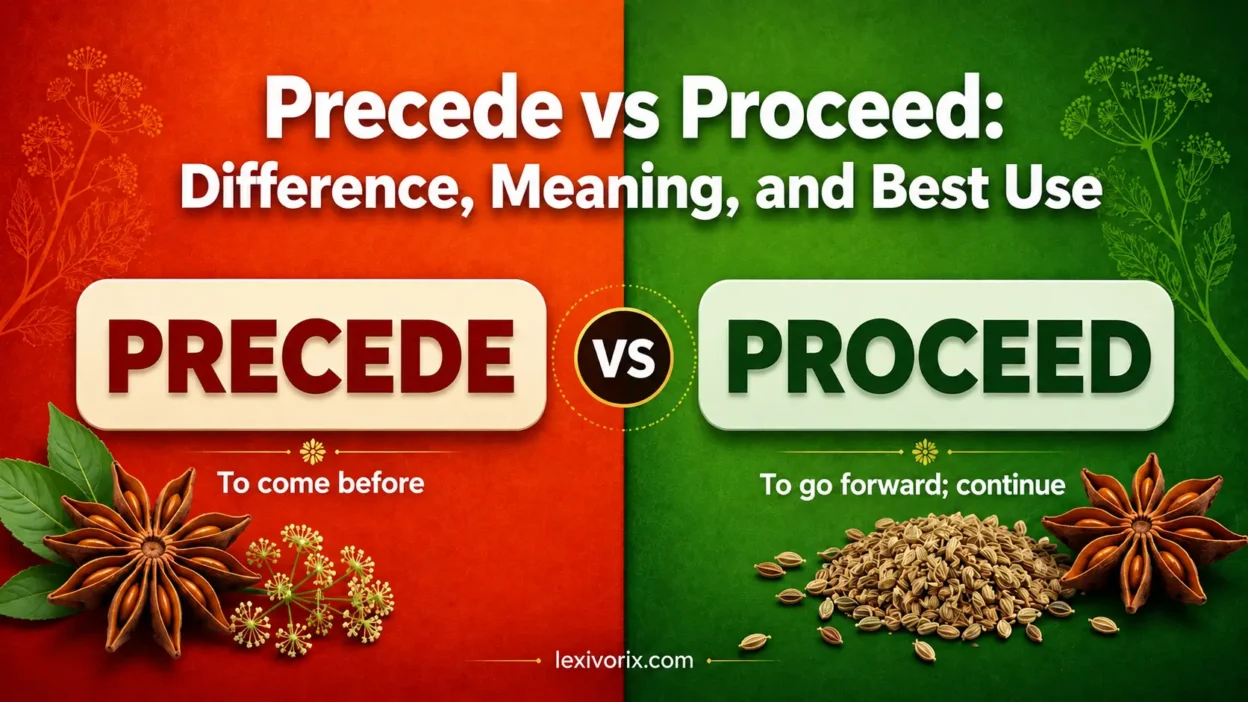
Choosing between precede vs proceed trips up writers, professionals, and students alike every day. Because both words share similar roots, sound almost identical in casual speech, and deal with order or motion, it is easy to swap one for the other when drafting an email, writing a report, or preparing a presentation. However, in written American English, precede vs proceed describe completely different directions of time and action.
Understanding precede vs proceed comes down to timing and direction. One word focuses on what comes before something else in time, order, or rank. The other word focuses on moving forward, continuing an action, or carrying on with a plan. Keeping the distinction between precede vs proceed clear ensures your writing remains precise, professional, and easy to understand.
Quick Answer
When evaluating precede vs proceed, look at whether you are talking about coming before or moving forward.
- Precede: To come, exist, or happen before something else in time, position, order, or rank.
- Proceed: To move forward, continue after a pause, or carry out an action.
These two words are not interchangeable in standard American English. Precede looks backward at what came earlier, while proceed looks forward at what happens next.
Time / Order Before: PRECEDE (looks backward/before)
Action / Motion Forward: PROCEED (looks forward/ahead)
Why People Confuse Them
The primary reason people confuse precede vs proceed comes down to pronunciation and spelling similarities. Both verbs feature the Latin root -cede or -ceed, which relates to yielding or going. In everyday spoken American English, the prefix pre- (pri- or pree-) and pro- (pruh- or proh-) can sound remarkably similar when spoken quickly.
Because both terms deal with order, sequence, or movement, writers often pick the wrong spelling by mistake. Remembering the prefix prefixes—where pre- means “before” (like prefix or pregame) and pro- means “forward” (like progress or promote)—solves the precede vs proceed confusion instantly.
Key Differences At A Glance
Here is a quick look at how precede vs proceed functions across different scenarios:
| Context | Best Choice | Why |
| A brief introduction before a speech | Precede | The opening remarks happen before the main address. |
| Continuing a meeting after a short break | Proceed | The group is moving forward with the agenda items. |
| Chapter 1 coming before Chapter 2 | Precede | Represents spatial or sequential placement earlier in a book. |
| Moving to the next stage of a project | Proceed | Refers to advancing forward into a new project phase. |
| Dark clouds appearing before a rainstorm | Precede | The clouds exist prior to the onset of the storm. |
Compact Comparison
- Feature: Core Direction | precede: Backward / Before | proceed: Forward / Ahead
- Feature: Key Prefix Cue | precede: pre- (like previous) | proceed: pro- (like progress)
- Feature: Primary Meaning | precede: To go or come before | proceed: To continue or move on
Meaning and Usage Difference
To master precede vs proceed, focus on the action taking place within your sentence structure.
Understanding Precede
To precede means to occur, exist, or go ahead of something else in time, order, or spatial arrangement. It sets up what happens earlier.
- Example: “A brief video overview will precede the main panel discussion.”
In this sentence, the video happens before the main discussion. The focus is strictly on order and sequence.
Understanding Proceed
To proceed means to go forward, advance, or continue an activity that has been started or planned. It drives action into the future.
- Example: “After addressing the initial questions, we will proceed with the product demonstration.”
Here, the speakers move forward to the next step. The focus is on progress and continuation.
Tone, Context, and Formality
Both precede and proceed are standard verbs in American English, widely used across academic, corporate, legal, and casual settings.
Neither term has a distinct informal equivalent, though proceed often sounds slightly more formal than simple alternatives like go ahead or keep going. In professional communications, choosing the correct term between precede vs proceed reflects accuracy and attention to detail.
Which One Should You Use?
Choosing between precede vs proceed is easy when you test the meaning of your sentence:
- Are you describing something that came earlier or placed ahead in order?
- Choose precede.
- Are you describing moving forward, advancing, or continuing an action?
- Choose proceed.
Decision Checklist
- Does it mean “to come before”? $\rightarrow$ precede
- Does it mean “to move forward”? $\rightarrow$ proceed
- Can you substitute “previous”? $\rightarrow$ precede
- Can you substitute “progress”? $\rightarrow$ proceed
When One Choice Sounds Wrong
Swapping these terms leads to sentences that sound unnatural or logically flawed:
- Incorrect: “Please precede to gate B12 for boarding.”
- Correct: “Please proceed to gate B12 for boarding.”
- Reason: Boarding requires physical movement forward to a location, which demands proceed.
- Incorrect: “The thunder proceeded the lightning strike.”
- Correct: “The lightning preceded the thunder.”
- Reason: Lightning comes prior to thunder in sequence, making precede the correct choice (along with fixing the physical order of events).
Common Mistakes (and Quick Fixes)
Here are frequent errors involving precede vs proceed and how to fix them:
- Mistake: Using precede when giving instructions to move forward.
- Fix: Swap in proceed whenever telling someone to go ahead or advance.
- Mistake: Spelling precede as preceed.
- Fix: Note the spelling difference: precede ends in -cede, while proceed ends in -ceed.
- Mistake: Confusing proceeds (noun) with precedes (verb).
- Fix: Remember that money earned from an event is called “the proceeds” (a noun related to proceed).
Everyday Examples
Here are modern examples of precede vs proceed in everyday scenarios:
- Workplace Email: “A quick safety briefing will precede the site tour tomorrow morning.”
- Project Management: “Once legal approves the contract, we can proceed with onboarding the new client.”
- Academic Writing: “The economic downturn that preceded the policy change lasted two years.”
- Travel Guidance: “Passengers may proceed through security once their tickets are scanned.”
Dictionary-Style Word Details
Verb
- precede: Transitive/intransitive verb meaning to come before in time, order, or rank. (Past tense: preceded, Present participle: preceding).
- proceed: Intransitive verb meaning to move forward or continue an action. (Past tense: proceeded, Present participle: proceeding).
Noun
- precede: Does not function as a noun. (Related noun forms: precedents, precedence).
- proceed: Does not function directly as a singular noun, but the plural form proceeds acts as a noun meaning earnings or revenue. (Related noun forms: procedure, procession).
Synonyms
- precede: Antedate, lead up to, pave the way for, foreshadow, introduce.
- proceed: Advance, continue, progress, move on, carry on, resume.
Example Sentences
- precede:
- Calm weather often precedes a sudden summer storm.
- The table of contents will precede the main chapters in the user guide.
- Remarks from the mayor will precede the ribbon-cutting ceremony.
- proceed:
- You may proceed with your presentation whenever you are ready.
- Construction workers will proceed with repairs after the inspection.
- The tour group decided to proceed down the mountain path before dusk.
Word History
- precede: Originates from the Latin praecedere, formed from prae- (before) and cedere (to go).
- proceed: Originates from the Latin procedere, formed from pro- (forward) and cedere (to go).
Phrases Containing
- precede: Precede by, precede in time, precede in rank.
- proceed: Proceed with caution, proceed to, proceed as planned, net proceeds.
Frequently Asked Questions
Look at the first two letters of each word. Precede starts like previous (coming before). Proceed starts like progress (moving forward).
This difference comes from how French adapted Latin roots before these words entered English. Precede, recede, and concede use -cede, whereas proceed, exceed, and succeed use -ceed.
Yes. When used in the plural, proceeds is a noun that refers to the money, profit, or yield obtained from an event, sale, or business transaction.
Conclusion
Understanding precede vs proceed comes down to timing and movement. Use precede when describing something that occurs earlier in time, order, or arrangement. Use proceed when describing advancing forward, carrying on, or continuing an action. Keeping precede vs proceed distinct will keep your communication accurate and effective.


