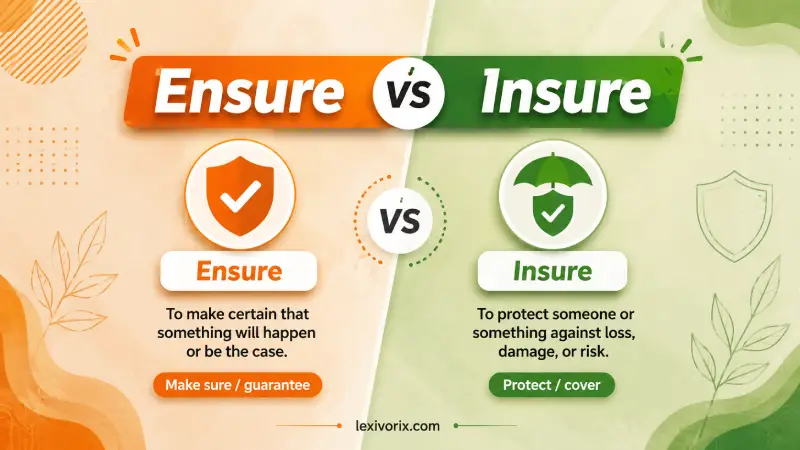
Ensure and insure look almost the same. They sound almost the same. And they both circle around one idea: making something certain. That’s exactly why so many careful writers still pause before typing either one.
The good news is the confusion has a clear cause, and the fix is simple once you see it. This guide breaks down ensure vs insure in plain terms, so you can pick the right word without a second thought.
Quick Answer
Use ensure when you mean “make certain” or “guarantee an outcome.” It’s the word for everyday actions and results.
Use insure when you’re talking about insurance: covering a car, a house, a business, or a life with a policy.
They are not fully interchangeable in current use. If money or a policy is involved, insure is the expected choice. If the sentence is about making sure something happens, ensure is the expected choice.
- Ensure: Double-checking the numbers will ensure the report is accurate.
- Insure: You’ll need to insure the truck before you can drive it off the lot.
Why People Confuse Them
The mix-up isn’t random. Both words trace back to the same root, and for a long stretch of English history, they were spelled interchangeably. Ensure came first, and insure started out as just another way to spell it.
Over time, insure picked up a narrower financial meaning tied to insurance policies, while ensure kept the broader, general sense of “making sure.” That split became the standard we follow today, but the shared background is exactly why the two still feel like cousins instead of strangers.
Key Differences At A Glance
| Context | Best Choice | Why |
|---|---|---|
| Making sure a task or outcome happens | Ensure | General “make certain” meaning |
| Covering property, health, or life with a policy | Insure | Financial/insurance meaning |
| Workplace safety or compliance | Ensure | No money or policy involved |
| Protecting a car, home, or business asset | Insure | Involves a paid policy |
| Guaranteeing quality or accuracy | Ensure | Outcome-focused, not financial |
Meaning and Usage Difference
Ensure is a regular verb that means to make certain or guarantee that something happens. It’s used with actions, outcomes, and conditions, not with policies or premiums.
Employees must ensure all equipment is turned off before leaving the building. The new schedule will ensure deliveries arrive on time.
Insure is also a regular verb, and its main job is to describe getting or providing insurance coverage. It shows up with things that carry financial risk, like vehicles, homes, health, and businesses.
She insured her jewelry collection right after the appraisal. Small businesses often insure their equipment against theft and fire.
Some dictionaries still list a secondary sense of insure that means “make certain,” left over from its older, broader use. That sense is far less common today, so it’s safer to stick with ensure whenever money or a policy isn’t part of the picture.
Tone, Context, and Formality
Neither word is more formal than the other. The real difference is subject matter, not tone.
Insure shows up almost entirely in financial, legal, and insurance writing. Think policy documents, claims, contracts, and money-related conversations.
Ensure shows up everywhere else: instructions, workplace emails, academic writing, product manuals, and everyday speech. You can use ensure in a casual text message or a formal report and it will fit either way, as long as the sentence is about making something certain rather than about coverage.
Which One Should You Use?
Ask yourself one question: Is this sentence about money, risk, or a policy, or is it about making sure something happens?
If the answer is money, risk, or a policy, use insure. He decided to insure the wedding in case of a last-minute cancellation.
If the answer is a general outcome or action, use ensure. Please ensure the doors are locked before you leave.
This test works for almost every situation you’ll run into, from casual writing to professional documents.
When One Choice Sounds Wrong
Swap the words and the sentence usually falls apart fast.
“Ensure your car before you drive it” sounds off, because ensure doesn’t carry the insurance-policy meaning in everyday use. The correct word is insure. ✗ Ensure your car before you drive it. ✓ Insure your car before you drive it.
“Insure the report is accurate” also sounds off, because there’s no policy or coverage involved, just a general outcome. The correct word is ensure. ✗ Please insure the report is accurate. ✓ Please ensure the report is accurate.
Common Mistakes (and Quick Fixes)
- Mistake: Using insure for general certainty in a work email. Fix: Swap in ensure. Ensure the client receives the invoice by Friday.
- Mistake: Using ensure when writing about a financial policy. Fix: Swap in insure. Insure the shipment before it leaves the warehouse.
- Mistake: Treating the two as always interchangeable. Fix: Run the quick test from the section above before you commit to either word.
- Mistake: Assuming one spelling is British and the other American. Fix: Both spellings are standard American English. The difference is meaning, not region.
Everyday Examples
Ensure your bags are packed the night before an early flight. The airline insures checked luggage against loss up to a set amount. A daily checklist can ensure nothing gets forgotten at the store. Homeowners often insure their house for more than the purchase price. The coach reminded the team to ensure every player had their gear. Freelancers sometimes insure their equipment in case of theft or damage. Please ensure your password meets the new security requirements. The dealership offered to insure the car for the first thirty days.
Dictionary-Style Word Details
Verb
- Ensure: A regular verb with the forms ensure, ensures, ensured, and ensuring. It means to make certain or guarantee something.
- Insure: A regular verb with the forms insure, insures, insured, and insuring. It means to provide or obtain insurance coverage, with an older, less common sense of “make certain.”
Noun
- Ensure: There’s no standard noun form in common use. The related noun “assurance” actually comes from a different word, assure.
- Insure: The related nouns are insurance and insurer. Insure itself doesn’t function as a noun.
Synonyms
- Ensure: Closest plain alternatives include guarantee, make certain, and see to it. None matches perfectly in every sentence, so treat these as close substitutes rather than exact matches.
- Insure: Closest plain alternatives include cover and protect financially. In British insurance writing, “assure” sometimes appears as a near match, but that use is regional and industry-specific rather than a general synonym.
Example Sentences
- Ensure: Testing the software twice will ensure it works on launch day. A backup generator can ensure the lights stay on during a storm.
- Insure: The gallery insured the painting for its full appraised value. Many drivers insure their vehicles the same day they buy them.
Word History
- Ensure: First recorded in the late 1300s, coming from an Anglo-French word built on “sure.” Its history is well documented across major dictionaries.
- Insure: First appeared as a spelling variant of ensure around the 1400s. It picked up its distinct financial meaning in the mid-1600s, and that history is also clearly documented.
Phrases Containing
- Ensure: “ensure that,” “ensure compliance,” “ensure safety”
- Insure: “insure against,” “self-insure,” “fully insured”
FAQs
Use these simple mnemonic tricks:
Ensure = Everything is certain / Effort to guarantee an outcome.
Insure = Insurance policy / Investment protection.
Assure = Allay doubts of a person.
Historically, the two terms were used interchangeably as regional spelling variants. Today, standard modern English (both American and British) treats them as distinct words.
However, some style guides (such as The New York Times) still permit using “insure” for broader meanings, and “insure” can occasionally mean “taking precautions” in figurative contexts. Despite this, modern professional and academic writing strictly separates them: use ensure for general guarantees and insure for financial policies.
While old texts or figurative expressions might use “insure” to mean “safeguard” or “protect” (e.g., “taking measures to insure victory”), modern usage overwhelmingly prefers ensure. Stick to ensure whenever money or insurance contracts are not involved.
Ensure becomes assurance or remains part of phrasing like giving a guarantee.
Insure becomes insurance (e.g., car insurance, health insurance).
Assure becomes assurance (e.g., words of assurance).
Both dialects follow the main rule: ensure = guarantee, insure = financial policy.The main difference appears with life insurance in the UK, where British English often uses the term “life assurance” instead of “life insurance” (because death is certain, whereas property damage is only a possibility).
Conclusion
Ensure vs insure comes down to one simple question: is this about money and coverage, or about making something certain? Once you can answer that, the right word picks itself.
They share a history, but they’ve grown into two different jobs. Keep insure for policies and financial protection, and keep ensure for everything else, and you’ll rarely second-guess yourself again.


