You may hear the word “inshallah” in movies, podcasts, or daily conversations. Friends might type it in group chats. You may see it in social media captions or news reports.
Because it appears in many places, its tone can change. Sometimes it carries deep religious meaning. Other times it works as a light, casual comment between friends.
Understanding this word helps you communicate across different cultures. It allows you to recognize when someone expresses genuine hope or polite doubt.
This guide explains the inshallah meaning in simple, plain English. You will learn its origins, spelling forms, slang uses, and grammar rules.
Quick Answer
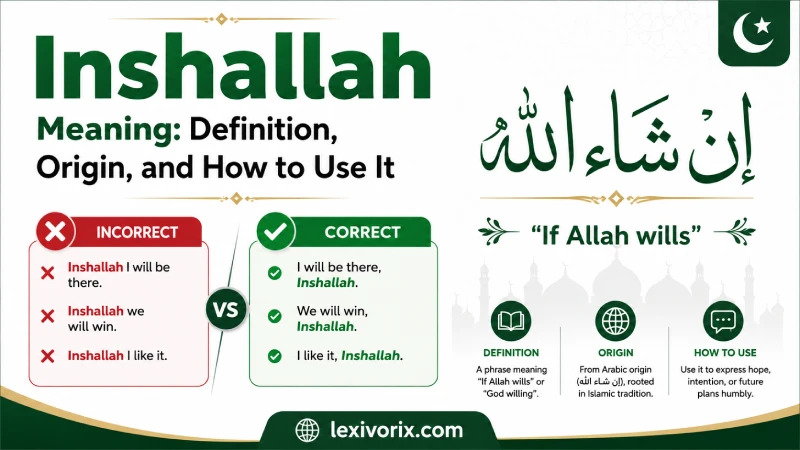
The inshallah meaning translates directly from Arabic as “if God wills” or “God willing.” People use it when talking about future plans to express hope for a good result.
TL;DR
• Translates to “if God wills” or “God willing.”
• Used when discussing future plans and hopes.
• Originates from Islamic scripture and the Arabic language.
• Functions as an adverb phrase or an interjection in English.
• Can mean a polite “maybe” in casual text messages.
• Has many spellings, including “insha Allah” and “insha’allah.”
What Is Inshallah? Core Meaning and Definition
“Inshallah” is an ancient Arabic expression used worldwide today. It combines three short Arabic words into one standard phrase.
The word expresses hope about future events. It shows that you want something to happen in the future. At the same time, it accepts that the future is uncertain.
When you say the word, you acknowledge human limits. You state your personal intent while recognizing that life can bring unexpected changes.
In plain English, it works like saying “hopefully” or “fingers crossed.” It connects human desire with a sense of humble expectation.
What Does “God Willing” Mean?
To understand “inshallah,” you must understand the phrase “God willing.” This phrase exists in almost every human language and culture.
“God willing” means that an event will happen if circumstances allow it. It shows that the speaker wants a goal to succeed.
In English, “God willing” carries the exact same weight as “if God wills it.” Both phrases point to future possibilities rather than current facts.
When translated into Arabic, “God willing” becomes “inshallah.” The two terms share the same purpose, tone, and logical function.
Arabic Roots and Word Breakdown
The phrase comes directly from classical Arabic script. In its traditional form, it consists of three distinct words:
• In: A conditional particle meaning “if.”
• Sha’a: A verb that means “willed” or “intended.”
• Allah: The standard Arabic word for “God.”
When you put these three pieces together, you get In sha’ Allah. Over centuries of spoken use, these words merged into one fluid sound.
In written Arabic, scholars prefer keeping the words separate. In English writing, however, combining them into one word is very common.
The phrase reminds speakers to remain humble. It teaches that humans can make plans, but ultimate control rests beyond human hands.
Common Spelling Variations and Misspellings
Because the phrase comes from Arabic, English writers use many different spellings. None of these spellings are wrong, but some are more common online.
Standard and Traditional Forms
• Inshallah: The most common single-word spelling in English dictionaries.
• In sha Allah: The traditional three-word form preferred by scholars.
• Insha’Allah: A punctuated form using an apostrophe for clarity.
• Inshaallah: A single-word variation without apostrophes or spaces.
Informal and Texting Variations
When people text quickly, they often drop spaces or apostrophes. You will see these informal versions on social media:
• Inshallah or Inshallah
• Inshalah or Inshala
• In shallah or In sha
Regional and Phonetic Variations
Different languages adopt the phrase using unique local phonetic rules:
• Insya Allah: Popular in Indonesia and Malaysia.
• Insallah: Common in Turkish and European writing.
• En shalla: A phonetic spelling based on spoken accents.
Common Misspellings and Typos
People often make typos when searching for this term online. Common typos include:
• Imshallah (replacing ‘n’ with ‘m’)
• Ishallah (dropping the ‘n’)
• Shallah (dropping the prefix entirely)
Despite the spelling differences, all these forms point to the exact same phrase and meaning.
How to Pronounce Inshallah Correctly
Pronouncing the word is simple once you break it down into three clear syllables.
Syllable Breakdown
The standard pronunciation is in-SHAH-lah or in-SHA-Allah.
- In: Sounds like the English word “in.”
- Shah: Sounds like “shah” with an open “ah” vowel.
- Lah: Sounds like “lah,” rhyming with “shah.”
Put the primary emphasis on the middle syllable, “SHAH.” Keep the transition between syllables smooth and natural.
Common Pronunciation Errors
• Avoid saying “in-SKAH-lah.” The middle sound is always “sh,” never “k.”
• Do not rush the ending. Let the last syllable sound clear and soft.
Part of Speech and English Grammar Rules
In English grammar, “inshallah” works as an interjection or an adverbial modifier phrase. It modifies a whole sentence about future actions.
You can place the phrase at the beginning, middle, or end of a sentence. Each position fits naturally into spoken English.
Position 1: At the Beginning
Starting with the word sets a hopeful tone right away.
Example: “Inshallah, our plane lands on time.”
Position 2: In the Middle
Placing it in the middle creates a smooth conversational flow.
Example: “We will, inshallah, see you at dinner tonight.”
Position 3: At the End
Putting it at the end adds a thoughtful tag to your thought.
Example: “I will complete the report by Friday, inshallah.”
Position 4: As a Standalone Response
You can use it as a complete answer to a question about the future.
Example: “Will you pass the exam?” — “Inshallah.”
Religious Significance in Islam and Other Faiths
The expression holds deep spiritual value in Islamic tradition. Sacred texts instruct believers to use the phrase whenever they state future plans.
It serves as a constant reminder of faith. It shows trust in divine wisdom while planning daily routines.
However, the word is not exclusive to Islam. Middle Eastern Christian communities have used the phrase for centuries in daily speech.
Jewish communities living in Arabic-speaking regions also use the term. To them, it represents a shared cultural way to discuss tomorrow.
Today, global business workers, diplomats, and students use it as well. It has become a truly universal expression of hope.
Cultural Usage and Everyday Conversations
In many parts of the world, “inshallah” is a basic pillar of polite conversation. Saying it shows good manners and positive intent.
When a neighbor asks if you will visit tomorrow, saying the word shows respect. It confirms that you want to visit while honoring reality.
In countries across North Africa, the Middle East, and South Asia, you will hear it dozens of times a day. It applies to big life goals and minor errands alike.
It appears when ordering food, booking travel, or starting work projects. It forms part of the natural rhythm of everyday speech.
Modern Slang and the “Polite Refusal”
In modern casual conversations, the phrase took on a secondary slang meaning. It often works as a polite “maybe” or a soft “we will see.”
People sometimes use it when they want to avoid saying a hard “no.” It allows the speaker to decline an invitation without causing hurt feelings.
The Parental “Maybe”
Parents frequently use this tactic with children.
When a child asks, “Can we go buy ice cream?” a parent might reply, “Inshallah.” In this context, it often means “probably not today, but we will see.”
The Social Texting Context
On text messaging apps, friends use it to answer uncertain party invites.
       [ INVITATION RECEIVED ]
                  │
                  ▼
   "Are you coming tonight?"
                  │
                  ▼
         [ SLANG RESPONSE ]
                  │
                  ▼
             "Inshallah"
                  │
   ┌──────────────┴──────────────┐
   ▼                             ▼
Sincere Intent              Polite "Maybe"
(Plan to attend)           (Unlikely to go)
This dual meaning creates popular internet memes. However, remember that most people still use the word with complete sincerity. Always pay attention to context and tone.
Practical Examples of Inshallah in Sentences
Here are realistic everyday examples showing how to use the phrase properly in standard English.
Category 1: Travel and Transportation
• “We will arrive at the airport by noon, inshallah.”
• “Inshallah, the weather will stay clear for our flight.”
• “The train leaves on schedule tomorrow morning, inshallah.”
Category 2: Career and Academic Goals
• “I will finish writing my paper tonight, inshallah.”
• “Inshallah, I will get the new job after my interview.”
• “Our team will launch the project next week, inshallah.”
Category 3: Health and Well-Being
• “Your doctor says you will heal quickly, inshallah.”
• “Inshallah, everyone stays safe during the winter storm.”
• “We hope for good news from the lab tests, inshallah.”
Category 4: Social Plans and Family
• “I will see you at the birthday party, inshallah.”
• “Inshallah, we will host a family dinner this weekend.”
• “We will visit our grandparents next month, inshallah.”
Each example looks forward to a positive future event. The phrase fits naturally into simple, everyday English thoughts.
When Not to Use Inshallah (Common Mistakes)
Using the word incorrectly can confuse listeners or sound awkward. Here are three key guidelines to avoid common mistakes.
1. Do Not Use It for Past Events
Never use the phrase when talking about things that already happened. It applies only to the future.
• Incorrect: “We arrived at the hotel yesterday, inshallah.”
• Correct: “We will arrive at the hotel tomorrow, inshallah.”
2. Do Not Pair It with Bad Deeds
Avoid using the word when talking about unethical or harmful actions. Pairing divine hope with bad intent is considered improper.
• Incorrect: “Inshallah, I will skip school and lie about it.”
• Correct: “Inshallah, I will study hard and pass my test.”
3. Do Not Overuse It Sarcastic Settings
While friends joke about the “polite maybe” slang, avoid using it mockingly in formal settings. Treat the word with basic respect when speaking to people who value it.
Related Arabic Terms: Inshallah, Mashallah, and Bismillah
English speakers often confuse “inshallah” with other common Arabic phrases. Learning the differences keeps your communication clear.
Inshallah vs. Mashallah
• Inshallah: Looks forward to the future (“God willing”).
• Mashallah: Looks at the present or past with gratitude (“God has willed it”).
Example: You say “inshallah” when planning a future wedding. You say “mashallah” when looking at beautiful wedding photos.
Inshallah vs. Bismillah
• Inshallah: Expresses hope for a future result.
• Bismillah: Means “in the name of God” and marks the start of an action.
Example: You say “bismillah” right before eating a meal. You say “inshallah” when hoping the meal tastes delicious.
Inshallah vs. Alhamdulillah
• Inshallah: Expresses desire for future success.
• Alhamdulillah: Means “praise be to God” and expresses thanks for present blessings.
Example: You say “alhamdulillah” after finishing a hard workday. You say “inshallah” when hoping tomorrow goes smoothly.
Context and Usage Quick Reference
These two reference tables help you choose the right terms and spellings for different situations.
| Situation | Recommended Expression | Primary Meaning |
| Planning tomorrow’s tasks | Inshallah | Expresses hope for future goals. |
| Starting a new project | Bismillah | Asks for blessings at the beginning of an action. |
| Celebrating good news | Mashallah | Shows appreciation for present blessings. |
| Giving thanks after success | Alhamdulillah | Offers gratitude for a completed task. |
| English casual alternative | God willing / Hopefully | Communicates future hope in standard English words. |
| Spelling Style | Formality Level | Common Usage Context |
| Inshallah | Standard | Books, media articles, and general English writing. |
| In sha Allah | Formal | Scholarly texts, formal letters, and religious guides. |
| Insha’Allah | Standard-Formal | Grammar guides and edited literary publications. |
| Inshallah / Insallah | Casual | Social media posts, informal emails, and online chats. |
| Insya Allah | Regional | Standard formal spelling in Malaysia and Indonesia. |
Mini Quiz: Test Your Understanding
Check your knowledge of the inshallah meaning with this quick self-test.
- What is the direct English translation of “inshallah”?a) Praise be to Godb) God willingc) In the name of God
- When is the correct time to use “inshallah”?a) When describing something that happened yesterdayb) When admiring a new car todayc) When discussing plans for next week
- Which phrase should you say right before you eat a meal?a) Bismillahb) Inshallahc) Mashallah
- Which syllable receives the strongest emphasis when speaking “inshallah”?a) The first syllable (IN)b) The middle syllable (SHAH)c) The last syllable (LAH)
- What does the word mean when used as modern texting slang?a) A hard “no”b) A polite “maybe” or “we will see”c) An immediate agreement
Answer Key
- b — “God willing” is the direct translation.
- c — Use it when talking about future events and goals.
- a — Say “Bismillah” at the start of an action like eating.
- b — Place the main vocal stress on “SHAH.”
- b — In casual texts, it often means a polite “maybe.”
FAQs
Yes, non-Muslims can say the phrase. Middle Eastern Christians, Jewish communities, and international travelers use it regularly.
In plain English, it means “if God wills” or “God willing.” People use it like the word “hopefully” when discussing future plans.
It has religious roots in Islam, but it is also a cultural phrase. Millions of people use it daily regardless of their personal faith.
In casual speech, people use it as a gentle answer when they cannot guarantee an outcome. It serves as a polite way to avoid making absolute promises.
“Inshallah” points toward future goals and hopes. “Mashallah” points toward present blessings, good news, or great achievements.
It is pronounced “in-SHAH-lah.” Place the primary verbal emphasis on the middle syllable, “SHAH.”
Both spellings are correct. “Inshallah” is standard in modern English writing. “In sha Allah” is preferred in formal religious transliteration.
“God willing” means that an event will happen if circumstances allow. It expresses hope that a future plan succeeds without unexpected problems.
You can reply by saying “inshallah” back to them. You can also say “thank you,” “sounds good,” or “hopefully!”
Conclusion
Understanding the inshallah meaning builds stronger communication across global cultures. It connects spiritual faith, traditional politeness, and modern daily speech.
Whether used as a sincere prayer or a hopeful comment, the word keeps us humble about tomorrow. Keep these practical usage rules in mind whenever you read, write, or say the phrase.


