Imagine reading a news article about a high-stakes court trial with a headline that reads: “The Judge Remained Uninterested Throughout the Proceeding.” That sentence probably paints a troubling picture in your mind. It suggests that the judge was leaning back, checking their watch, scrolling through their phone, or perhaps even fighting off a nap while attorneys presented their arguments.
Now imagine if the headline said: “The Judge Remained Disinterested Throughout the Proceeding.” In standard English, that sentence describes the highest ideal of the legal system. It means the judge was completely fair, free from conflict of interest, unbiased, and objective.
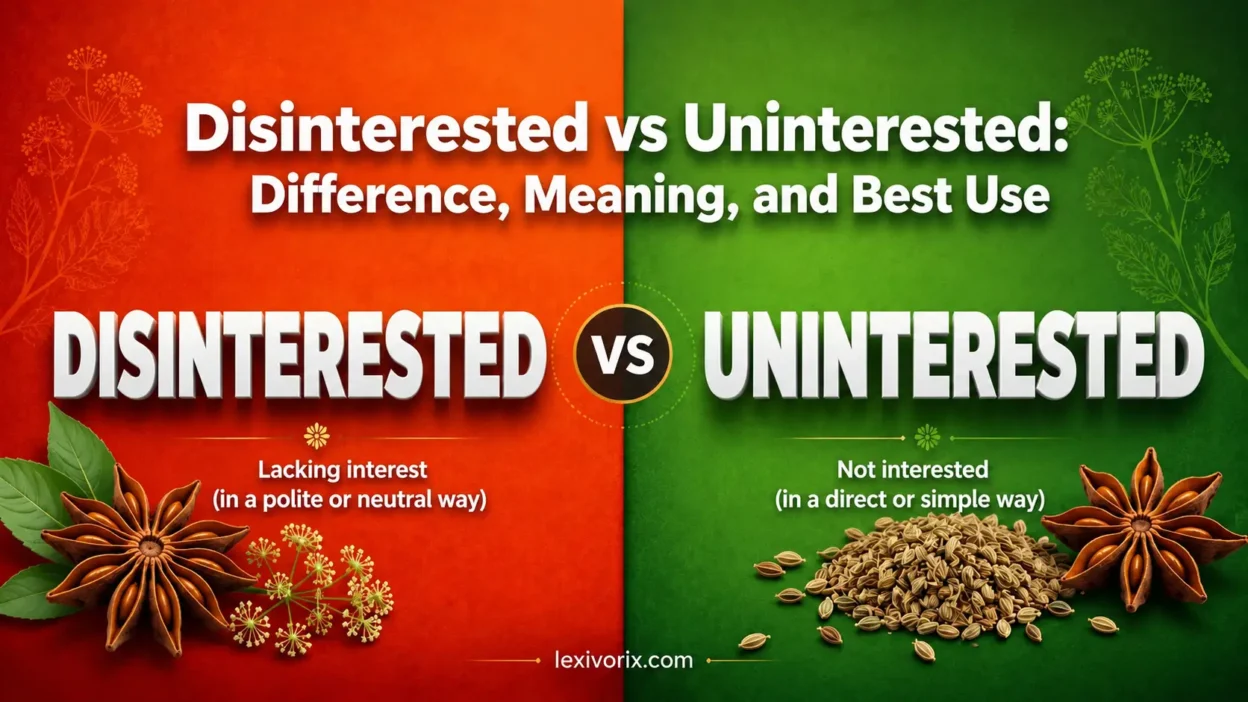
While both words share the root word “interested,” they approach that root from two entirely different angles. One refers to your personal stake or bias in a situation, while the other refers to your level of curiosity or engagement. Because both words begin with negative prefixes (dis- and un-), speakers and writers frequently swap them in casual speech.
However, mixing up disinterested vs uninterested in professional, legal, academic, or journalistic writing can accidentally flip the meaning of your sentence upside down. Understanding the clear boundary between having no personal bias and having no attention to give ensures your writing remains precise, polished, and unambiguous.
Quick Answer
The difference between disinterested and uninterested comes down to whether you are talking about fairness or boredom:
- Disinterested means impartial, neutral, or unbiased. A disinterested person has no personal stake, financial involvement, or emotional bias in the outcome of a situation.
- Uninterested means not interested, bored, or unconcerned. An uninterested person simply lacks curiosity, enthusiasm, or attention regarding a subject.
To make the distinction stick in your mind, think about these two brief scenarios:
A disinterested sports referee makes fair calls because they do not care which team wins.
An uninterested sports spectator falls asleep in the bleachers because they do not care about football.
In formal, academic, legal, and professional writing, these two words are never interchangeable. While casual conversation sometimes blurs them, maintaining the boundary preserves a crucial word for objectivity that English otherwise lacks.
Why People Confuse Them
If the distinction between being unbiased and being bored seems clear-cut, why do so many writers stumble over disinterested and uninterested? The confusion is rooted in word structure, historical language shifts, and modern speech patterns.
1. Overlapping Prefixes
Both dis- and un- are negative prefixes in English that mean “not” or “opposite of.” When attached to “interested,” both form words that describe a lack of interest. The confusion happens because the word “interest” itself carries two distinct meanings in the English language:
- A personal stake or benefit: As in “a financial interest” or “a conflict of interest.”
- A feeling of curiosity or concern: As in “taking an interest in art” or “showing interest in a conversation.”
Disinterested negates the first meaning (having no personal stake or conflict), while uninterested negates the second meaning (having no curiosity or attention).
2. A Historical Flip-Flop
Part of the confusion comes from historical English usage. In the 17th century, the definitions of these two words were actually reversed! Writers in the 1600s sometimes used “disinterested” to mean bored or unconcerned, and “uninterested” to mean impartial.
By the late 18th century, however, language conventions settled into their modern roles. For over two centuries, standardized English dictionaries, legal statutes, and literary works have assigned “impartial” strictly to disinterested and “indifferent” to uninterested.
3. Modern Casual Drift
In everyday spoken English, people frequently use “disinterested” when they really mean “uninterested” (for example, saying “I was disinterested in the movie”). Because listeners can usually deduce the intended meaning from context, this casual habit persists. However, major style guides strictly penalize this usage in written prose because using “disinterested” as a synonym for “bored” leaves English without a single, concise word to describe someone who is completely free of bias.
Key Differences At A Glance
To help you decide which word fits your sentence immediately, review the decision framework below:
| Context | Best Choice | Why |
| Evaluating a court judge, jury member, or mediator | disinterested | You need someone neutral who has no personal conflict of interest |
| Describing a student who is bored during a lecture | uninterested | The student lacks curiosity or enthusiasm for the subject matter |
| Choosing a third-party financial auditor | disinterested | The auditor must be free of financial ties to the firm being audited |
| Explaining why someone declined an invitation to an event | uninterested | The person simply has no desire or motivation to attend |
| Selecting a sports umpire or referee | disinterested | The official must treat both competing teams with equal fairness |
| Describing an audience member checking their phone | uninterested | The person is unengaged and paying no attention to the presentation |
To analyze how these two terms function side by side, review their full grammatical and semantic profile:
| Feature | disinterested | uninterested |
| Primary Meaning | Impartial, neutral, unbiased, conflict-free | Bored, unconcerned, indifferent, lacking curiosity |
| Focus Area | Personal stake, profit, or prejudice | Attention, enthusiasm, or intellectual engagement |
| Key Synonym | Objective / Nonpartisan | Apathetic / Unconcerned |
| Key Antonym | Biased / Partisan / Self-interested | Curious / Fascinated / Eager |
| Common Noun Form | Disinterestedness (Impartiality) | Uninterestedness / Indifference |
| Typical Setting | Legal, judicial, academic, auditing, journalism | Casual conversation, personal feelings, general behavior |
Meaning and Usage Difference
Understanding how disinterested and uninterested function in standard English requires looking at the specific job each word performs in a sentence.
The Mechanics of “Disinterested”
When you describe someone as disinterested, you are commenting on their neutrality. You are stating that they have no horse in the race, no hidden agenda, no personal bias, and no financial investment in how things turn out.
Because a disinterested person stands to gain nothing regardless of the outcome, they are in an ideal position to make fair judgements, mediate disputes, or evaluate evidence.
- “We need a disinterested party to mediate the contract negotiations between management and the union.”
- “A disinterested panel of scientific experts reviewed the clinical trial data to verify the findings.”
- “The company hired a disinterested accounting firm to conduct the annual audit.”
In each of these sentences, replacing “disinterested” with “uninterested” would imply that the mediators, scientists, or accountants were lazy or bored, completely undermining the point of the sentence.
The Mechanics of “Uninterested”
When you describe someone as uninterested, you are commenting on their lack of enthusiasm, curiosity, or attention. You are stating that the person simply does not care about the topic, activity, or event.
An uninterested person is not necessarily acting as an official judge or mediator; they are simply disengaged or bored.
- “Marcus seemed completely uninterested in discussing the new office software.”
- “She was uninterested in buying a new car until her old one broke down.”
- “The children were uninterested in the museum exhibit and wanted to go outside.”
Here, “uninterested” clearly describes a state of mind where someone lacks interest, motivation, or desire to engage.
Tone, Context, and Formality
While casual conversation sometimes treats these words as synonyms, professional environments demand strict adherence to their distinct meanings.
Legal and Judicial Contexts
In legal writing, precision is paramount. A “disinterested witness” is a witness who has no relationship to either party in a lawsuit and no personal stake in the trial’s verdict. Calling a witness “uninterested” in a legal document implies that the witness is unresponsive, uncooperative, or paying no attention to the questioning—a completely different legal situation.
Journalism and Media (AP Style)
The Associated Press (AP) Stylebook, which governs news reporting across the United States, enforces a clear rule:
Use disinterested to mean impartial or unbiased. Use uninterested to mean not interested.
A news reporter covering an election must remain a disinterested observer. If a reporter were uninterested, they wouldn’t bother covering the election at all.
Academic and Publishing Guidelines (Chicago Manual of Style)
The Chicago Manual of Style and major university style guides heavily emphasize preserving the distinction. In academic peer reviews, scholars reviewing a research paper must be disinterested—meaning they have no competing financial interests or personal rivalries with the authors.
Which One Should You Use?
When drafting a sentence and deciding between disinterested and uninterested, run your scenario through two simple mental tests.
Test 1: The Conflict of Interest Test
Ask yourself: Is there money, personal gain, or prejudice involved?
- If you are asking whether someone has a conflict of interest or a bias, choose disinterested.
- Question: “Does this judge have any personal investment in the company being sued?”
- Answer: “No, the judge is completely disinterested.”
Test 2: The Yawn Test
Ask yourself: Is someone yawning, bored, or paying no attention?
- If you are describing someone who is bored, indifferent, or ignoring something, choose uninterested.
- Question: “Is Alex listening to the presentation on quarterly tax updates?”
- Answer: “No, Alex looks completely uninterested and is reading a magazine.”
When One Choice Sounds Wrong
Using the wrong word can dramatically alter the meaning of your sentence, often leading to unintended comedy or professional confusion. Examining these incorrect statements shows why accuracy matters.
Example 1: The Accidental Insult
Wrong: “Our company chose Sarah as the head of the ethics committee because she is completely uninterested.”
Why it fails: Saying Sarah is “uninterested” implies she doesn’t care about ethics, won’t attend meetings, and finds the committee’s work boring.
Correct: “Our company chose Sarah as the head of the ethics committee because she is completely disinterested.”
(This correctly means Sarah has no personal conflicts of interest and will make fair, unbiased decisions.)
Example 2: The Over-Engineered Casual Sentence
Wrong: “I offered him a slice of pizza, but he was disinterested in eating.”
Why it fails: Using “disinterested” here sounds overly stiff and incorrectly implies that eating pizza involves a complex legal conflict of interest.
Correct: “I offered him a slice of pizza, but he was uninterested in eating.”
(This correctly means he wasn’t hungry or didn’t feel like eating pizza.)
Common Mistakes (and Quick Fixes)
Review these common sentence slips and their immediate corrections to keep your writing accurate:
- Slip: Describing a bored student as “disinterested”
- Incorrect: “The teacher noticed several disinterested students sleeping in the back row.”
- Correction: “The teacher noticed several uninterested students sleeping in the back row.”
- Reason: The students are bored and unengaged, not serving as neutral legal judges.
- Slip: Describing an unbiased mediator as “uninterested”
- Incorrect: “To resolve the contract dispute fairly, we must hire an uninterested arbitrator.”
- Correction: “To resolve the contract dispute fairly, we must hire a disinterested arbitrator.”
- Reason: You need an arbitrator who is neutral and unbiased, not someone who doesn’t care about doing their job.
- Slip: Misusing prepositions with disinterested
- Incorrect: “She was disinterested to learn about the new company policy.”
- Correction: “She was uninterested in learning about the new company policy.”
- Reason: Lacking curiosity pairs with “uninterested in,” whereas neutrality pairs with being a “disinterested party.”
Everyday Examples
Here are realistic examples illustrating how both words function across workplace, academic, journalistic, and casual settings:
Workplace & Corporate Settings
- “To ensure transparency during the merger, the board appointed a disinterested financial advisor to value the assets.”
- “Several team members appeared uninterested during the lengthy slideshow presentation on compliance software.”
- “As a disinterested third party, HR was able to evaluate both employees’ claims without taking sides.”
Academic & Scientific Writing
- “Peer review relies on disinterested scholars who evaluate research manuscripts purely on scientific merit.”
- “High school students who are uninterested in traditional lectures often excel in hands-on vocational workshops.”
- “The study required a disinterested group of observers to record animal behaviors without human interference.”
Legal & News Reporting
- “The defense attorney argued that the jury was not truly disinterested due to extensive pre-trial media coverage.”
- “Voters seemed largely uninterested in the local ballot initiative, resulting in record-low turnout at the polls.”
- “Journalists are expected to maintain a disinterested stance when reporting on political campaigns.”
Everyday Casual Conversation
- “I tried watching that new sci-fi series, but I was completely uninterested after the first episode.”
- “When settling arguments between my two kids, I try to remain as disinterested as an official referee.”
- “He was so uninterested in football that he didn’t even know which teams were playing in the championship.”
Dictionary-Style Word Details
Verb
disinterested
- Function as a verb: Neither disinterested nor its root forms function as a verb in modern standard English. In archaic contexts, “disinterest” was occasionally used as a verb meaning “to divest of personal interest or bias,” but this usage is obsolete.
uninterested
- Function as a verb: Uninterested functions strictly as an adjective. It does not exist as a verb form in English.
Noun
disinterested
- Derived Noun Form: Disinterestedness (noun).
- Definition: The quality of being impartial, unbiased, or free from personal conflict of interest.
- Example: “The judge was praised for her absolute disinterestedness throughout the complex trial.”
uninterested
- Derived Noun Form: Uninterestedness (noun) or indifference (noun).
- Definition: The state of lacking curiosity, concern, or enthusiasm. (Note: Indifference or apathy is much more common in natural English prose than uninterestedness).
- Example: “His total indifference to the team’s victory disappointed his friends.”
Synonyms
disinterested
- Primary Synonyms: Impartial, unbiased, neutral, objective, nonpartisan, dispassionate, detached, fair-minded, open-minded.
- Closest Plain Alternatives: Fair, neutral, conflict-free.
- Antonyms: Biased, prejudiced, partisan, self-interested, partial, slanted.
uninterested
- Primary Synonyms: Indifferent, bored, unconcerned, apathetic, unmoved, unmotivated, detached, disengaged, incurious.
- Closest Plain Alternatives: Bored, unconcerned, not interested.
- Antonyms: Curious, interested, enthusiastic, eager, fascinated, keen.
Example Sentences
disinterested
- “A disinterested investigator was brought in from another police precinct to review the internal conduct complaint.”
- “Financial regulations require mortgage advisors to provide disinterested guidance that benefits the homebuyer.”
- “Although she had personal opinions on the matter, she maintained a disinterested demeanor while chairing the debate.”
- “The committee sought a disinterested opinion from an independent engineering firm before approving the bridge design.”
uninterested
- “Despite the salesman’s enthusiastic pitch, the customer remained visibly uninterested in buying the warranty.”
- “If students feel that the material has no real-world application, they quickly become uninterested.”
- He was so uninterested in fashion that he wore the exact same style of shirt every day for ten years.
- “She sat quietly in the back corner of the room, completely uninterested in the loud political debate happening around her.”
Word History
disinterested
The word disinterested first entered the English language in the early 1600s, constructed from the prefix dis- (denoting privation, removal, or separation) and interested (having a legal or personal share in something). Originally derived from the Latin interesse (“to be between” or “to make a difference”), the word carried an explicit legal and financial meaning: having no personal property, claim, or financial stake in a matter.
uninterested
The word uninterested also appeared in the early-to-mid 1600s, built from the prefix un- (meaning “not”) and interested. In the 17th century, English writers briefly used both words interchangeably, sometimes swapping their roles. However, by the late 1700s, grammarians, lexicographers, and legal scholars firmly established disinterested to mean “free from personal bias” and uninterested to mean “lacking curiosity or attention.” This distinction has been protected by style manuals ever since.
Phrases Containing
disinterested
- Disinterested party: A person or group that has no personal stake or bias in a legal proceeding or business transaction.
- Disinterested observer: An independent witness who watches events unfold without participating or taking sides.
- Disinterested advice: Guidance given purely for the recipient’s benefit, free from hidden agendas or personal profit motives.
- Disinterested decision-maker: An official, judge, or referee who evaluates facts objectively without favoritism.
uninterested
- Completely uninterested: Entirely lacking enthusiasm or attention toward a subject.
- Appear uninterested: Showing body language (such as checking a watch or looking away) that signals boredom or distraction.
- Uninterested in the outcome: Having no curiosity or care regarding how a situation finishes.
Frequently Asked Questions
In casual spoken English, many people use disinterested to mean bored or indifferent. Dictionaries acknowledge this informal usage because it happens frequently in speech. However, in formal writing, journalism, law, and academic prose, using disinterested to mean uninterested is considered a grammatical error. Style guides like AP and Chicago strictly enforce the distinction.
A classic example of a disinterested person is a jury member in a court trial. Jury members must have no personal connection to the defendant, no financial stake in the outcome, and no prior prejudice. They are disinterested because they are neutral, but they are certainly not uninterested—they must pay close attention to all the evidence presented.
A disinterested judge is ideal because they have no conflict of interest in the case before them. They do not know the parties personally, hold no financial shares in the companies involved, and stand to gain nothing regardless of who wins. This neutrality guarantees that their ruling will be based solely on the law and evidence.
The opposite of disinterested is biased, prejudiced, partisan, or self-interested. Someone who stands to gain money or power from a specific decision is the opposite of a disinterested observer.
Yes, uninterested is a fully standard, formal English word. It is the proper, professional choice whenever you want to state that someone lacks interest, curiosity, or engagement in a topic.
Think of the DIS in disinterested as standing for “Detached perspective” or “Dispassionate observer.” Think of the UN in uninterested as standing for “Unmotivated” or “Unconcerned.”
Conclusion
Mastering the difference between disinterested vs uninterested is one of the easiest ways to bring precision and authority to your writing. While casual conversation often blurs the lines between these two words, keeping them distinct in your professional and academic work ensures your exact meaning is communicated without confusion.
Whenever you find yourself choosing between them, remember the core difference: disinterested means having no personal bias or conflict of interest, while uninterested means having no curiosity or attention to give. By applying these simple rules, you can write with total confidence, knowing you have chosen the exact word for the job.


