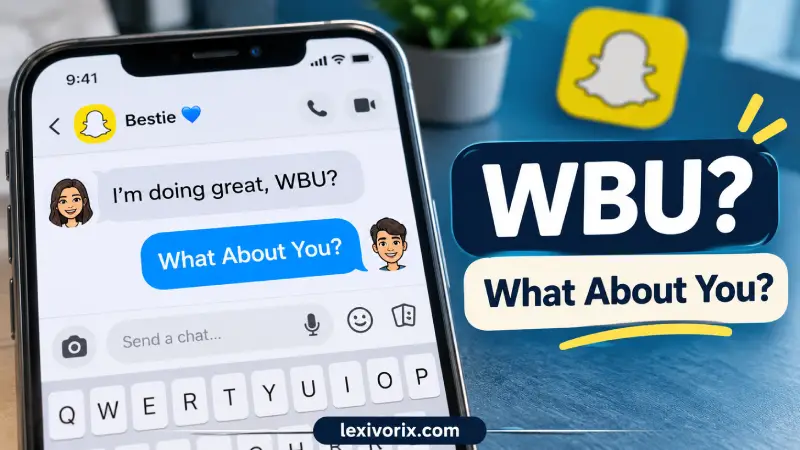
If someone sends you “WBU?” on Snapchat, they probably want to know something about you. You might see this abbreviation after answering a question about your day, plans, feelings, or favorite things.
WBU is a popular texting abbreviation that stands for “What About You?” It gives the other person an easy way to return a question without typing the entire phrase. For example, someone might write, “I’m watching a movie tonight, WBU?”
This expression is common in casual digital conversations. People use it in Snapchat messages, text conversations, social media chats, and other online discussions.
However, understanding the full form is only the beginning. The surrounding conversation can help you understand exactly what someone wants to know. This guide explains the WBU meaning on Snapchat, practical examples, natural replies, and common misunderstandings.
Quick Answer: What Does WBU Mean on Snapchat?
WBU means “What About You?” on Snapchat. It is an informal abbreviation used to return a question or ask someone about their feelings, activities, preferences, or plans.
For example:
“Just finished my homework. WBU?”
This means:
“Just finished my homework. What about you?”
What Does WBU Stand For?
WBU stands for What About You?
It is a shortened expression used in everyday digital communication. Instead of typing three separate words, someone can use three letters to communicate the same question.
Each letter represents part of the original expression:
- W = What
- B = About
- U = You
Together, these letters form WBU.
The abbreviation is especially useful when people exchange short messages. It allows someone to answer a question and invite the other person to share their own answer.
For example:
Person A: How was your weekend?
Person B: It was amazing! WBU?
Person A: Pretty good. I went shopping with my family.
Here, Person B answers the original question and then asks about the other person’s weekend.
Is WBU an Acronym or an Abbreviation?
WBU is commonly described as a texting abbreviation or initialism. Its letters represent the first letters of the words in “What About You?”
People generally pronounce the individual letters rather than treating WBU as one spoken word.
It belongs to informal internet language. It is not normally used in academic writing, business documents, or formal correspondence.
What Is the Difference Between WBU and Its Full Form?
The meaning stays the same whether someone writes the abbreviation or the complete phrase.
| Expression | Meaning | Communication style |
|---|---|---|
| WBU? | What about you? | Informal |
| What about you? | Same question | Standard English |
| And you? | Asking for your response | Natural conversation |
For example:
- “I’m feeling great, WBU?”
- “I’m feeling great, what about you?”
- “I’m feeling great. And you?”
All three expressions invite the other person to share how they feel.
What Does WBU Mean in a Snapchat Conversation?
On Snapchat, WBU usually means “What About You?” The meaning does not change because someone uses the abbreviation on this particular platform.
Snapchat users often exchange short messages while discussing everyday activities. WBU fits naturally into these conversations because it keeps the discussion moving.
Imagine someone asks whether you are free this weekend. You reply:
“I’m free on Saturday. WBU?”
The other person understands that you are asking about their availability.
Similarly, someone might send:
“I’m listening to my favorite playlist rn, WBU?”
Here, WBU asks what the recipient is doing.
Why Do People Send WBU on Snapchat?
There are several ordinary reasons someone might use this expression.
- To return a question: Someone answers your question and wants to hear your response.
- To continue a conversation: The abbreviation gives the other person an easy opportunity to reply.
- To share interests: People use it when discussing music, movies, food, games, and hobbies.
- To exchange updates: Friends can use it to talk about their day, school, or weekend plans.
- To keep messages short: Three letters are convenient when sending quick replies.
WBU does not have a secret Snapchat-specific meaning. Its intended meaning normally comes from the message before it.
Does WBU Have a Different Meaning in Snapchat Streaks?
Not usually. WBU still stands for “What About You?” when it appears in a conversation involving Snapchat streaks.
For example:
“I’m bored today, WBU?”
The sender is asking whether you are bored or doing something interesting.
However, a message containing WBU does not necessarily mean someone wants to start a long conversation. Sometimes it is simply a quick response.
How People Use WBU on Snapchat
WBU can appear in several kinds of conversations. Its meaning remains consistent, but the subject changes according to the discussion.
Here are some common situations.
During Everyday Conversations
Friends often use WBU when discussing how their day is going.
Example:
Friend: I’m having a pretty good day!
You: Nice! What made it good?
Friend: Finished everything early. WBU?
You: Mine has been busy, but good.
The abbreviation makes the exchange feel natural and relaxed.
When Discussing Weekend Plans
People can use WBU to ask about another person’s plans.
Example:
Friend: I’m going to the mall tomorrow. WBU?
You: I might visit my cousins.
In this situation, WBU means “What about you?” regarding weekend activities.
When Talking About School
Students may use WBU when discussing classes, assignments, or school activities.
Example:
Friend: I finished my science assignment. WBU?
You: I’m still working on the last question.
This is a simple way to exchange updates.
When Sharing Personal Interests
The abbreviation also works when people discuss entertainment and hobbies.
Example:
Friend: I really enjoy mystery movies. WBU?
You: I prefer comedy movies.
Here, the sender wants to know your preference.
When Discussing Food
WBU can help people exchange opinions about meals.
Example:
Friend: I had pizza for lunch. WBU?
You: I had a sandwich.
It is a quick way to ask about another person’s experience.
Real Examples of WBU in Snapchat Messages
The easiest way to understand WBU is to see how it works in realistic conversations.
Below are examples covering different everyday situations.
Example: Asking How Someone Feels
Message:
“I’m feeling much better today, WBU?”
Meaning:
“I’m feeling much better today. What about you?”
The sender is asking about your feelings.
Example: Discussing Daily Activities
Message:
“Just got home from school, WBU?”
Meaning:
“I just got home from school. What about you?”
The sender wants to know what you are doing.
Example: Talking About Music
Message:
“I’m listening to Taylor Swift. WBU?”
Meaning:
“I’m listening to Taylor Swift. What about you?”
The sender is inviting you to share your current music choice.
Example: Discussing Movies
Message:
“I watched a really good comedy last night. WBU?”
Meaning:
“I watched a really good comedy last night. What about you?”
The sender may want to know what you watched.
Example: Asking About Weekend Plans
Message:
“I’m staying home this weekend. WBU?”
Meaning:
“I’m staying home this weekend. What about you?”
The sender is asking about your weekend plans.
Example: Discussing Food Preferences
Message:
“I love chocolate ice cream. WBU?”
Meaning:
“I love chocolate ice cream. What about you?”
The sender wants to know your favorite flavor or preference.
Example: Talking About Games
Message:
“I’m playing Minecraft right now. WBU?”
Meaning:
“I’m playing Minecraft right now. What about you?”
The sender is asking about your current activity.
Example: Discussing Travel
Message:
“I would love to visit New York someday. WBU?”
Meaning:
“I would love to visit New York someday. What about you?”
The sender wants to hear about your travel interests.
Example: Talking About Weather
Message:
“It’s raining here today. WBU?”
Meaning:
“It’s raining here today. What about you?”
The sender is asking about the weather where you are.
Example: Sharing an Opinion
Message:
“I think the new song is really good. WBU?”
Meaning:
“I think the new song is really good. What about you?”
The sender wants to know whether you share the same opinion.
These examples show that WBU can fit many everyday subjects. The main purpose is always to invite the other person to respond.
How to Reply When Someone Sends WBU
Replying to WBU is simple. You do not need a special phrase or complicated response.
First, look at the message that came before WBU. Then answer the question or topic being discussed.
For example:
Friend: I’m watching a movie. WBU?
You: I’m doing my homework.
Your response directly answers the question.
Here are several other natural replies.
If Someone Asks About Your Day
Them: My day was great! WBU?
You can reply:
- “Mine was pretty good too!”
- “A little busy, but I’m doing fine.”
- “It was okay. Nothing special happened.”
- “Really good! I had a lot of fun.”
If Someone Asks What You Are Doing
Them: Just relaxing at home, WBU?
You can reply:
- “I’m watching a show.”
- “Just finishing my homework.”
- “I’m listening to music.”
- “Nothing much, just chilling.”
If Someone Asks About Your Plans
Them: I’m going shopping tomorrow. WBU?
You can reply:
- “I haven’t made any plans yet.”
- “I’m visiting my grandparents.”
- “Probably staying home.”
- “I might go out with my friends.”
If Someone Asks About Your Opinion
Them: I think this movie is amazing. WBU?
You can reply:
- “I agree! It’s really good.”
- “I actually prefer the first movie.”
- “It’s okay, but not my favorite.”
- “I haven’t watched it yet.”
Can You Reply With WBU Too?
Yes, but it depends on the conversation.
You can use WBU when you have already shared your answer and want to return the same question.
Example:
Friend: I love summer. WBU?
You: I prefer winter, WBU?
Friend: Summer is still my favorite!
However, repeating WBU without providing an answer can make a conversation feel repetitive. Giving your own response first is usually more natural.
Should You Reply Immediately?
No special response time is required.
You can reply whenever it is convenient. WBU is an ordinary conversational question, not a demand for an immediate answer.
If you are busy, you can respond later with a simple explanation.
For example:
“Sorry, I was studying. I’m doing pretty well!”
Does WBU Have a Flirty or Romantic Meaning?
WBU does not automatically have a flirty or romantic meaning.
Its normal definition is simply “What About You?” Anyone can use it in a friendly conversation.
For example:
“I’m having a great day, WBU?”
This is an ordinary question. It does not prove that the sender has romantic feelings.
However, the surrounding conversation can influence how a message feels.
Consider these situations:
Friendly conversation:
“Just finished watching a movie. WBU?”
This is a normal question about someone’s activities.
A more personal conversation:
“I always enjoy talking with you. WBU?”
This sounds more personal because of the additional words.
A conversation about shared interests:
“I love spending time with my friends. WBU?”
The sender wants to know about your preferences.
The important point is that WBU itself does not communicate romantic interest.
Does WBU Mean Someone Likes You?
Not necessarily.
Someone might use WBU because they are being polite, showing ordinary interest, or continuing a conversation.
You should not assume someone likes you based on these three letters alone.
Look at the broader conversation instead. A single abbreviation cannot reliably explain someone’s feelings or intentions.
Is WBU Rude or Disrespectful?
No. WBU is not inherently rude or disrespectful.
It is generally a friendly and neutral expression. People use it to show interest in another person’s answer.
For example:
“I’m doing well today, WBU?”
This sounds like an ordinary exchange.
However, the way someone uses WBU can affect how their message feels.
When WBU Sounds Friendly
WBU usually sounds friendly when someone first answers a question.
Example:
“I’m great! WBU?”
The sender has responded and is giving you an opportunity to share.
When WBU Might Sound Uninterested
A message containing only “wbu?” can sometimes feel less personal.
For example:
You: “I had a really interesting day at school.”
Them: “Wbu”
This response may feel short because it does not directly acknowledge what you shared.
Still, it does not necessarily mean the person is being rude. They may simply prefer brief messages.
Does Capitalization Affect the Tone?
Usually, no.
These versions generally have the same meaning:
- WBU?
- wbu?
- Wbu?
- WBU
The capitalization does not create a different definition. The question mark simply makes the question clearer.
WBU vs. HBU, WYD, and WYA
Several texting abbreviations look similar because they appear in everyday conversations.
However, they do not all ask the same question.
Understanding their meanings can help you interpret messages correctly.
| Abbreviation | Full form | Purpose |
|---|---|---|
| WBU | What About You? | Returns a question |
| HBU | How About You? | Asks about the other person |
| WYD | What You Doing? | Asks about someone’s activity |
| WYA | Where You At? | Asks about someone’s location |
| HRU | How Are You? | Asks about someone’s well-being |
| WYD RN | What You Doing Right Now? | Asks about current activity |
WBU vs. HBU
WBU means “What About You?”
HBU means “How About You?”
These expressions are very similar in casual messaging. Both can be used to ask someone for their answer.
Example:
“I’m doing great, WBU?”
“I’m doing great, HBU?”
Both messages ask how the other person is doing.
WBU vs. WYD
WYD means “What You Doing?”
WBU means “What About You?”
The first directly asks about someone’s activity. The second returns a question or asks about their situation.
Example:
“I’m studying. WBU?”
This asks what the other person is doing in the context of the conversation.
“WYD?”
This directly asks what the person is currently doing.
WBU vs. WYA
WYA means “Where You At?”
It is used to ask about someone’s location.
WBU has a broader meaning. It can ask about activities, feelings, plans, interests, and opinions.
Example:
“I’m at home. WBU?”
This asks about the other person’s situation.
“WYA?”
This asks where the person is.
WBU vs. HRU
HRU means “How Are You?”
It is commonly used to ask someone about their well-being.
WBU can follow an answer to HRU.
Example:
- Person A: HRU?
- Person B: I’m good, WBU?
- Person A: I’m doing great!
These abbreviations often appear together in casual conversations.
When Should You Use WBU?
WBU is appropriate when you are having a relaxed conversation with someone who understands texting abbreviations.
It is especially useful when you want to return a question without repeating the complete phrase.
Here are situations where it works naturally.
When Chatting With Friends
You can use WBU when talking about everyday activities, entertainment, hobbies, or personal preferences.
Example:
“I’m going to watch a movie tonight. WBU?”
When Messaging Classmates
It can also appear in informal conversations with classmates.
Example:
“I finished the assignment. WBU?”
Keep school-related instructions and formal messages clear, though.
When Talking in Group Chats
WBU can help invite another person to share an opinion.
Example:
“I think Friday works best. WBU?”
It is especially useful when everyone is discussing the same subject.
When Responding to a Question
WBU is useful after you have answered someone.
Example:
Friend: What’s your favorite subject?
You: English. WBU?
This keeps the conversation balanced.
When Should You Avoid Using WBU?
Although WBU is useful in casual messaging, it is not suitable for every situation.
Some readers may not understand the abbreviation. Others may prefer complete sentences.
In formal communication, clarity is more important than shortening a phrase.
In Professional Emails
Avoid writing WBU in formal emails to teachers, employers, clients, or people you do not know well.
Instead of:
“I’m available tomorrow. WBU?”
Write:
“I’m available tomorrow. What about you?”
The complete expression sounds clearer and more professional.
In Academic Assignments
Do not use WBU in essays, research papers, school assignments, or formal written answers.
Use standard English expressions instead.
In Important Conversations
If you are discussing something serious, typing the complete phrase may sound more thoughtful.
For example:
“I’m concerned about the situation. What about you?”
This is clearer than relying on an abbreviation.
When Messaging Someone Unfamiliar With Texting Slang
Some people may not recognize WBU.
If you are unsure whether someone understands it, write “What about you?” instead.
Clear communication prevents unnecessary confusion.
Common Mistakes People Make With WBU
WBU is easy to understand, but a few misunderstandings can occur.
Knowing these mistakes helps you use the expression naturally.
Thinking WBU Has a Secret Snapchat Meaning
Some people assume abbreviations have completely different meanings on different platforms.
However, WBU generally keeps the same meaning across Snapchat, Instagram, WhatsApp, and regular text messages.
It stands for “What About You?”
Assuming WBU Is Always Flirty
WBU is not automatically romantic.
A friend, classmate, relative, or acquaintance can use it in an ordinary conversation.
The broader context determines the tone.
Confusing WBU With WYD
These abbreviations have different meanings.
WBU asks about the other person’s situation or opinion. WYD directly asks what someone is doing.
Understanding the difference prevents incorrect replies.
Using WBU in Formal Writing
WBU is an informal abbreviation.
Using it in a formal assignment or professional email can make the message seem too casual.
Write the complete phrase instead.
Believing Uppercase and Lowercase Forms Mean Different Things
WBU and wbu generally mean exactly the same thing.
The difference is simply capitalization.
Both are understood in casual digital conversations.
Other Texting Abbreviations Related to WBU
If you understand WBU, you may encounter other short expressions in everyday messages.
Here are some useful abbreviations:
| Abbreviation | Full form | Meaning |
|---|---|---|
| HBU | How About You? | Asks for your response |
| WYD | What You Doing? | Asks about your activity |
| WYA | Where You At? | Asks about your location |
| IDK | I Don’t Know | Shows uncertainty |
| TBH | To Be Honest | Introduces an honest opinion |
| IMO | In My Opinion | Shares a personal opinion |
| LMK | Let Me Know | Requests an update |
| RN | Right Now | Refers to the present |
| BTW | By The Way | Introduces additional information |
| NGL | Not Gonna Lie | Introduces a candid statement |
| FR | For Real | Expresses agreement or sincerity |
| WYD RN | What You Doing Right Now? | Asks about current activity |
These expressions can make casual conversations shorter and easier to follow.
However, their meanings depend on the surrounding message. Learning the full forms makes online conversations easier to understand.
Frequently Asked Questions About WBU
What does WBU mean on Snapchat?
WBU means “What About You?” on Snapchat. It is a casual abbreviation used when someone wants to know about your activities, feelings, plans, or opinions. For example, “I’m staying home tonight, WBU?” asks what you are doing.
What does WBU mean in text messages?
In text messages, WBU stands for “What About You?” People use it after sharing their own answers or experiences. It helps keep conversations going without typing the complete phrase.
What does WBU mean from a girl?
When a girl sends WBU, she is generally asking “What About You?” The abbreviation has the same meaning regardless of who sends it. It does not automatically indicate romantic interest.
How should you reply when someone says WBU?
Answer the question or topic being discussed. For example, if someone says, “I’m watching a movie, WBU?” you could respond, “I’m listening to music.” You can also ask a related question to continue the conversation.
Is WBU the same as HBU?
They have very similar meanings. WBU stands for “What About You?” while HBU means “How About You?” Both expressions are commonly used to return questions in casual conversations.
Is WBU rude or disrespectful?
No, WBU is generally a friendly and neutral expression. However, a very short reply can sometimes feel less personal. The surrounding conversation helps determine the intended tone.
Can I use WBU on Instagram and WhatsApp?
Yes. WBU can be used on Instagram, WhatsApp, Snapchat, and regular text messages. Its basic meaning remains “What About You?” across these platforms.
Conclusion
WBU means “What About You?” and is a simple abbreviation used in casual digital conversations. On Snapchat, people use it to exchange answers, discuss everyday activities, and keep conversations moving.
When someone sends you WBU, simply answer the question they are discussing. Remember that it is informal language, so use the complete phrase in professional and academic communication.