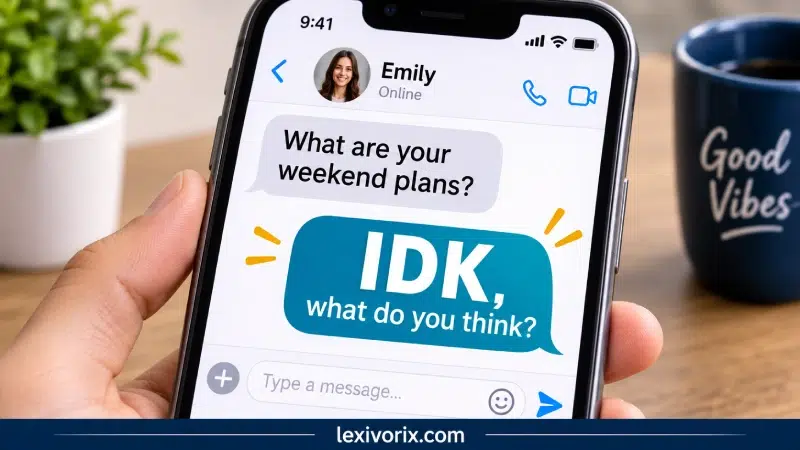
You might see three short letters while chatting with friends: IDK. They often appear in text messages, social media comments, and online conversations.
If someone asks about your weekend plans, you might receive a simple response: “IDK.” This small abbreviation communicates something important without requiring a complete sentence.
Many people use IDK when they feel unsure or lack an answer. It can also express indecision during everyday conversations.
Understanding this abbreviation makes digital communication easier. It also helps you recognize the tone behind short messages.
In this guide, you’ll discover what IDK means, what its letters represent, and how people use it. You’ll also find practical examples, pronunciation guidance, and related expressions.
Quick Answer
What does IDK mean? IDK stands for “I don’t know.” It is an informal abbreviation used in texting, online chats, and social media to express uncertainty or a lack of information.
TL;DR
- IDK means “I don’t know.”
- It is commonly used in text messages.
- It expresses uncertainty or indecision.
- Both IDK and idk have the same meaning.
- It is informal rather than professional language.
- People pronounce it as individual letters.
What Does IDK Mean in Texting?
IDK means “I don’t know” when someone uses it in a text message. It is a quick way to communicate uncertainty without typing the complete phrase.
People commonly use it when answering questions or discussing plans. It also appears in group chats, gaming conversations, and social media comments.
Here are some everyday examples:
- Friend: Are you coming to the movies tonight?
- You: IDK. I haven’t checked my schedule.
Another example:
- Friend: What’s the homework assignment?
- You: IDK. I missed the last class.
In both conversations, IDK communicates that the person does not have the answer.
The abbreviation does not always suggest a negative attitude. Its meaning remains the same, although the surrounding conversation can affect its tone.
What Does IDK Stand For?
IDK is an abbreviation of three words: I Don’t Know.
Each letter represents part of the original expression.
| Letter | Represents |
|---|---|
| I | I |
| D | Don’t |
| K | Know |
Together, these letters create IDK.
It is technically an initialism because people pronounce its letters individually. It is also commonly described as a texting abbreviation.
The expression became associated with digital communication, particularly online chats and text messaging. Its exact origin is not firmly established.
People usually write it in uppercase or lowercase. Both forms communicate the same basic message.
How IDK Is Used in Different Contexts
IDK has one central definition, but its conversational purpose can change. Understanding the situation helps you interpret the message correctly.
Here are four common ways people use it.
1. Expressing Uncertainty
Someone might use IDK when they genuinely don’t have an answer.
Example: “IDK where I left my headphones.”
This simply communicates missing information.
2. Showing Indecision
People also use IDK when they cannot choose between options.
Example: “IDK whether I should order pizza or burgers.”
The person needs more time or help making a decision.
3. Giving a Casual Response
Sometimes, IDK keeps a conversation relaxed and informal.
Example:
- Friend: What should we watch tonight?
- You: IDK, you choose!
Here, the speaker leaves the decision open.
4. Expressing Frustration or Confusion
IDK can also appear when someone feels confused about a situation.
Example: “IDK why the internet keeps disconnecting.”
The abbreviation communicates uncertainty about what is happening.
Important: IDK does not automatically mean someone is angry, uninterested, or ignoring you. Consider the complete conversation before interpreting its tone.
How to Use IDK in a Sentence
You can use IDK anywhere the complete phrase “I don’t know” would make sense in casual writing.
It commonly appears at the beginning of a sentence or as a complete reply.
Here are practical examples:
Example 1: Answering a Question
“IDK what time the store closes.”
Meaning: The speaker doesn’t know the closing time.
Example 2: Discussing Plans
“IDK if I’ll be available this weekend.”
Meaning: The speaker hasn’t confirmed their availability.
Example 3: Talking About School
“IDK the answer to question five.”
Meaning: The student doesn’t know the answer.
Example 4: Messaging a Friend
“IDK, maybe we should go tomorrow.”
Meaning: The speaker is suggesting a possible alternative.
Example 5: Responding to a Group Chat
“IDK what everyone wants to eat.”
Meaning: The speaker doesn’t know the group’s food preferences.
Example 6: Expressing Confusion
“IDK how that happened!”
Meaning: The speaker cannot explain the situation.
These examples show how IDK fits naturally into everyday digital conversations.
When Should You Use IDK?
IDK works best in relaxed conversations where people understand informal language.
You can comfortably use it in these situations:
- Text messages: When answering friends or family.
- Group chats: When discussing shared plans.
- Social media: When commenting casually on posts.
- Online gaming: When responding to teammates.
- Everyday conversations: When communicating through informal messages.
For example, a friend might ask, “Are you free tomorrow?”
You could reply, “IDK yet. I’ll let you know.”
This sounds natural in a casual conversation.
Remember that your audience matters. Some people prefer complete words, even in ordinary messages.
When Should You Avoid Using IDK?
Although IDK is widely understood, it is not suitable for every situation.
Avoid using it in formal writing or important professional communication. Spelling out the phrase usually sounds clearer and more respectful.
Consider these examples:
| Context | Best Choice | Why |
|---|---|---|
| Texting a friend | IDK | Casual and convenient |
| School essay | I don’t know | More appropriate writing |
| Email to a teacher | I’m not sure | Polite and clear |
| Professional email | I don’t have that information yet | More professional |
| Group chat | IDK | Informal communication |
For example, avoid writing:
“IDK when the project will be finished.”
Instead, write:
“I’m not sure when the project will be finished.”
You can also provide a helpful next step:
“I’ll confirm the deadline and update you tomorrow.”
This communicates uncertainty without sounding dismissive.
10. How Do You Pronounce IDK?
IDK is pronounced by saying each letter separately.
Eye-Dee-Kay
/ˌaɪ diː ˈkeɪ/
- I sounds like “eye.”
- D sounds like “dee.”
- K sounds like “kay.”
People generally use IDK in writing rather than saying the letters aloud.
In everyday speech, most people simply say “I don’t know.”
IDK vs. Related Texting Abbreviations
Several texting abbreviations look similar to IDK. However, they communicate different ideas.
Understanding these expressions helps prevent confusion.
IDK — I Don’t Know
This expresses uncertainty or missing information.
Example: “IDK where she went.”
IDC — I Don’t Care
This communicates a lack of concern or interest.
Example: “IDC which movie we watch.”
IDEK — I Don’t Even Know
This is a stronger, more expressive version of IDK. People often use it when something feels especially confusing.
Example: “IDEK what happened yesterday.”
IDRK — I Don’t Really Know
This expresses uncertainty, often with a softer or less definite tone.
Example: “IDRK if they’re coming tonight.”
These expressions are informal and usually appear in casual digital conversations.
Common Mistakes When Using IDK
People sometimes misunderstand IDK because short messages lack conversational details.
Watch out for these mistakes:
– Mistake: Thinking IDK means “I don’t care.”
Correction: IDK means “I don’t know.” IDC means “I don’t care.”
– Mistake: Assuming IDK always sounds rude.
Correction: Its tone depends on the situation and surrounding words.
– Mistake: Using IDK in formal essays.
Correction: Write the complete phrase instead.
– Mistake: Thinking lowercase idk has a different definition.
Correction: Both capitalization styles communicate the same meaning.
Mini Quiz: Test Your Understanding
Try these questions to check what you’ve learned.
1. What does IDK stand for?
- A. I Don’t Know
- B. I Do Know
- C. I Don’t Care
2. Which situation is best for using IDK?
- A. A formal job application
- B. A casual text to a friend
- C. An academic essay
3. What does IDC mean?
- A. I Don’t Know
- B. I Don’t Care
- C. I Do Care
Answer Key:
- A — I Don’t Know
- B — A casual text to a friend
- B — I Don’t Care
Frequently Asked Questions
1. What does IDK mean in texting?
IDK means “I don’t know.” People use it in text messages when they lack information or feel uncertain about something.
2. What does IDK stand for?
IDK stands for the three words “I Don’t Know.” Each letter represents the beginning of one word.
3. Is IDK considered slang?
IDK is an informal texting abbreviation rather than a traditional slang expression. People commonly use it in online conversations and social media.
4. Is IDK rude or disrespectful?
Not necessarily. IDK is usually neutral, but a very short reply can sometimes seem dismissive. Adding more words can make your response sound friendlier.
5. Can I use IDK in formal writing?
It is better to avoid IDK in academic and professional writing. Use phrases such as “I’m not sure” or “I don’t have that information.”
6. What is the difference between IDK and IDC?
IDK means “I don’t know,” while IDC means “I don’t care.” One communicates uncertainty, and the other communicates a lack of concern.
7. Does IDK mean the same thing in uppercase and lowercase?
Yes. IDK and idk have the same basic meaning. The capitalization usually reflects personal writing style or emphasis.
Conclusion
IDK is a simple abbreviation that stands for “I don’t know.” It helps people communicate uncertainty quickly in everyday digital conversations.
Now that you understand what does IDK mean, you can recognize and use it naturally. Try it in casual conversations, and choose complete expressions when writing formally.