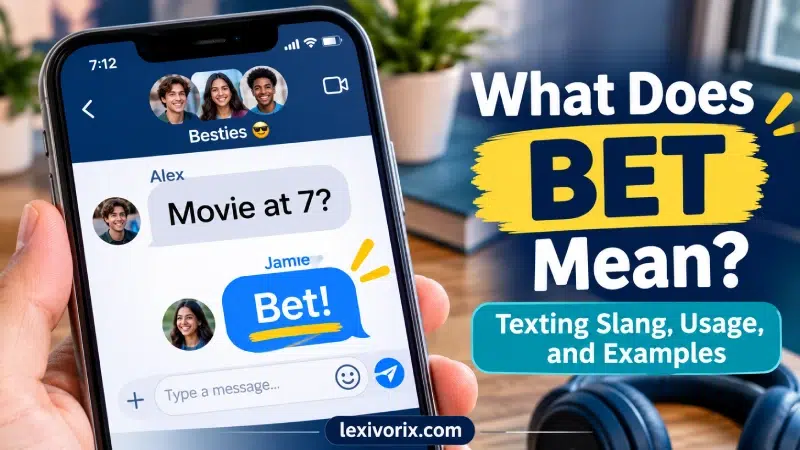
You might see someone reply “bet” after receiving an invitation or suggestion. Perhaps a friend sends, “Want to get pizza after school?” and the answer is simply, “Bet.” If you are unfamiliar with this expression, the reply can seem confusing.
In modern American slang, bet usually means “okay,” “sure,” “agreed,” or “sounds good.” It can also show confidence or accept a challenge. People use it in text messages, group chats, social media comments, and everyday conversations.
However, bet has traditional meanings too. It can refer to a wager, or it can express a strong belief about something. This guide explains what bet means, how people use it, and how context changes its tone. You will also learn its pronunciation, grammar, history, and common mistakes.
Quick Answer
What does bet mean? In texting and slang, bet usually means “okay,” “agreed,” “deal,” or “I’m in.” It can also mean “challenge accepted” when someone responds to a challenge.
TL;DR
- Bet often means okay, sure, or agreed.
- It can confirm plans or accept a challenge.
- The tone may be friendly, confident, or sarcastic.
- Bet is an ordinary word, not an acronym.
- It is informal and best suited to casual conversations.
- Context helps reveal the speaker’s intended meaning.
What Does Bet Mean?
The word bet has several meanings, depending on how someone uses it. In modern slang, it is usually an affirmative expression. That means it communicates agreement, approval, or acceptance.
For example:
- Person A: “Want to watch a movie tonight?”
- Person B: “Bet!”
- Person B is saying, “Sure, that sounds good.” They are accepting the suggestion.
In another conversation, bet can communicate confidence or a willingness to prove something.
Person A: “You can’t finish that level.”
Person B: “Bet.”
Here, the reply means “Challenge accepted.” The speaker is ready to try.
The slang expression is short, direct, and relaxed. It can replace a longer response when both people understand the situation.
The Main Slang Meanings
Depending on the conversation, bet can communicate several related ideas:
- Okay: The person accepts what someone suggested.
- Agreed: The person supports a plan or decision.
- Deal: Both people have reached an understanding.
- I’m in: The person wants to participate.
- For sure: The person expresses confidence.
- Challenge accepted: The person is ready to prove something.
- Understood: The person acknowledges a message.
These meanings overlap, but they are not always interchangeable. The message before the reply usually makes the intended meaning clear.
What Does Bet Mean in Texting?
In text messages, bet is commonly a short way to agree or confirm something. It saves time and keeps conversations casual.
Friends may use it when making plans, sharing information, or responding to requests. It can also show that someone is ready to participate in an activity.
Consider these realistic examples.
Example: Confirming plans
Alex: “Meet me outside the library at 4?”
Jordan: “Bet.”
Jordan means, “Okay, I’ll meet you there.”
Example: Accepting a request
Mia: “Can you send me the homework notes?”
Taylor: “Bet, I’ll send them after class.”
Taylor is agreeing to help.
Example: Joining an activity
Sam: “We’re playing basketball this afternoon. You coming?”
Chris: “Bet, I’ll be there.”
Chris is saying that they want to join.
Example: Acknowledging information
Riley: “The meeting starts at 10 tomorrow.”
Casey: “Bet, thanks.”
Casey understands and acknowledges the information.
Why Is Bet Used as a One-Word Reply?
People sometimes prefer short messages instead of complete sentences. A single word can communicate enough when the conversation already provides the details.
For example, if someone asks, “Pizza after class?” the answer “Bet” can be perfectly clear. There is no need to repeat the entire plan.
However, a one-word reply does not always communicate every detail. If the time, location, or arrangement is uncertain, ask a follow-up question.
Example:
Friend: “Let’s meet tomorrow.”
You: “Bet. What time?”
This response agrees while asking for the missing information.
What Does Bet Mean on Social Media?
On social media, bet generally carries the same meaning as it does in texting. People use it to agree, acknowledge a statement, or respond confidently.
You may see it in comments, direct messages, captions, and group conversations. Its meaning still depends on the surrounding discussion.
Bet on TikTok
A person might comment “Bet” when a creator promises to share another video. It can show that the viewer is interested and expects the promise to happen.
Example:
Creator: “I’ll post the next part tomorrow.”
Comment: “Bet!”
The commenter means, “Okay, I’m looking forward to it.”
It can also appear under videos involving friendly challenges or personal goals.
Bet on Snapchat
On Snapchat, people may use bet as a quick reply to an invitation or plan.
Example:
Friend: “I’ll message you when I’m outside.”
Reply: “Bet.”
The reply means, “Okay, I understand.”
Bet on Instagram
Instagram users can write bet in comments or direct messages. It may show agreement with a suggestion or confirm an arrangement.
Example:
Message: “I’ll share the pictures tonight.”
Reply: “Bet, thanks!”
The person is acknowledging the promise.
Bet in Gaming Chats
Gaming conversations often involve quick decisions and friendly challenges. Bet can show that someone accepts a match, agrees to join, or feels confident about a result.
Example:
- Player A: “One more round?”
- Player B: “Bet.”
- Player B agrees to play another round.
Different Ways People Use Bet
Although bet often means agreement, it does not always express the same feeling. The speaker’s tone and the previous message can change its meaning.
Bet Means Okay or Sure
This is a common use in casual conversation. Someone says bet when they accept a suggestion or request.
Example:
Friend: “Can you bring your notebook tomorrow?”
Reply: “Bet.”
The person means, “Sure, I’ll bring it.”
Bet Means Deal
People use bet to confirm an arrangement. It can make a plan feel settled.
Example:
Person A: “Let’s meet at the coffee shop at 5.”
Person B: “Bet. See you there.”
Here, bet means “Deal” or “That works for me.”
Bet Means I’m In
When someone suggests an activity, bet can show interest and willingness to participate.
Example:
Friend: “We’re watching a movie this weekend. Want to come?”
Reply: “Bet, I’m in.”
The person accepts the invitation.
Bet Means Challenge Accepted
A different meaning appears when someone responds to a challenge. In this situation, bet communicates confidence or determination.
Example:
Person A: “I don’t think you can solve this puzzle.”
Person B: “Bet. Give me a minute.”
The speaker accepts the challenge and wants to prove they can do it.
This use may sound playful or competitive. It does not necessarily mean the people are arguing.
Bet Can Express Doubt or Sarcasm
Sometimes bet has a skeptical meaning. A person may use it when they do not fully believe another person’s claim.
Example:
Person A: “I’ll finish the entire project in five minutes.”
Person B: “Yeah, bet.”
Depending on the tone, Person B may mean, “I don’t really believe that.”
This interpretation is different from friendly agreement. A short reply can sound sarcastic, especially when it follows an unlikely claim.
How to Use Bet in a Sentence
Bet works naturally in informal conversations. You can use it as a short reply or include it at the beginning of a longer message.
Here are several examples:
- “You want to get lunch? Bet.”
- “Bet, I’ll bring the snacks.”
- “We’re meeting at six? Bet, see you then.”
- “You think you can beat my score? Bet.”
- “Bet, I’ll check the message later.”
- “You said the tickets are ready? Bet, thanks.”
The word usually sounds most natural when the situation is relaxed. It is common in conversations between friends and people who already know each other.
Use Bet as a Short Reply
A single-word reply works when the meaning is already clear.
Example:
“Are you joining us?”
“Bet.”
This is direct and casual.
Use Bet Before an Explanation
You can also add more information after the word.
Example:
“Bet, I’ll finish my part tonight.”
This confirms the request and explains what the speaker will do.
Use Bet When Accepting a Challenge
When someone doubts your ability, bet can express confidence.
Example:
“You won’t remember all the answers.”
“Bet. I’ll study and try.”
The speaker is accepting the challenge without needing a long response.
Avoid Using It Without Clear Context
A message that only says “bet” may confuse someone who does not know the expression. It may also be unclear when the previous message contains several questions.
Instead, add a few words.
Less clear: “Bet.”
Clearer: “Bet, I’ll meet you at 5.”
The second message confirms the plan more precisely.
How to Pronounce Bet
The word bet is pronounced /bet/. It has one syllable and a short vowel sound.
It rhymes with common English words such as:
- Get
- Let
- Set
- Met
- Net
Say it as one quick sound: bet.
The slang meaning does not change the pronunciation. Whether someone means agreement, confidence, or a traditional wager, the word sounds the same.
Is Bet an Acronym?
No. In ordinary texting slang, bet is not an acronym. It does not normally stand for a longer phrase.
It is an existing English word that people also use as an informal expression of agreement.
This is different from abbreviations such as LOL or BRB. Those expressions are formed from the first letters of longer phrases.
Why Do People Write BET in Capital Letters?
Capital letters usually add emphasis. They do not create a new full form.
For example:
- bet — relaxed agreement.
- BET! — stronger excitement or confidence.
- Bettt! — playful emphasis or enthusiasm.
The exact feeling depends on the conversation. Extra letters and punctuation can change the tone without changing the basic meaning.
Also, BET can refer to the name of a television network. That is a separate use of the same letters, not the meaning of the slang reply.
The Origin and History of Bet
The slang use of bet is connected to older affirmative expressions such as “you bet.” That phrase has long been used to express certainty or agreement.
Dictionary.com explains that the affirmative expression was used by the nineteenth century. The newer standalone slang use is recorded in the 1990s.
The expression is also associated with African American English and Black popular culture. It later spread through music, youth conversations, and wider online communication.
It is difficult to identify one person or exact moment that created the slang use. Language develops through communities and everyday conversations. For that reason, it is safer to describe its development rather than claim a single inventor.
Today, bet is familiar in many informal American conversations. It appears in messages, comments, and spoken replies.
Bet as a Noun and Verb
Bet is not only slang. It is also a standard English word that functions as both a noun and a verb.
Understanding these roles helps prevent confusion when you see it in different sentences.
Bet as a Noun
As a noun, bet can mean an agreement involving a wager. It can also refer to the amount involved in that arrangement.
Examples:
- “We made a bet about the final score.”
- “That was a risky bet.”
- “Her best bet is to ask for more information.”
In the last example, “best bet” means the most sensible choice or option. It does not necessarily refer to gambling.
Bet as a Verb
As a verb, bet can mean to risk something on an uncertain result. It can also mean that someone feels sure about something.
Examples:
- “I bet we will arrive before sunset.”
- “She bet that her team would win.”
- “I wouldn’t bet on that happening.”
In everyday speech, “I bet” often introduces a confident guess.
Bet as an Informal Interjection
In slang, bet often works as an interjection. An interjection is a word or expression that communicates a reaction or feeling.
Examples:
- “Bet! Let’s go.”
- “Aight, bet.”
- “You think I can’t do it? Bet.”
In these examples, bet communicates agreement, acceptance, or confidence. It does not describe an action involving a wager.
Common Verb Forms
The standard verb has these common forms:
| Form | Example |
|---|---|
| Base form | I bet on the result. |
| Present participle | They are betting on the outcome. |
| Past tense | She bet that we would win. |
| Past participle | He has bet on similar events before. |
The past tense and past participle are commonly bet. The form betted also exists, but bet is the usual form in everyday English.
Similar Expressions and Related Terms
Several expressions can communicate ideas similar to slang bet. However, each has a slightly different tone or purpose.
You Bet
“You bet” is an informal expression that usually means “certainly,” “of course,” or “absolutely.”
Example:
Person A: “Can you help me tomorrow?”
Person B: “You bet!”
The response expresses a positive and confident agreement.
I Bet
“I bet” can introduce a belief, guess, or prediction. It often means that the speaker feels something is likely.
Example:
“I bet they’ll arrive early.”
The speaker believes they will arrive early, but does not claim to know for certain.
For Sure
“For sure” expresses clear agreement or certainty. It is casual but works in more situations than some slang expressions.
Example:
Friend: “Are you coming to the game?”
Reply: “For sure.”
I’m Down
“I’m down” means that someone is willing or interested in joining an activity.
Example:
Friend: “Want to try the new restaurant?”
Reply: “I’m down.”
It communicates interest and willingness.
Say Less
“Say less” often means “I understand” or “you don’t need to explain more.” It can also show that someone is ready to help or participate.
Example:
Friend: “Can you bring your favorite board game?”
Reply: “Say less.”
The speaker understands the request and is ready to follow through.
Facts
“Facts” is often used to agree with a statement that someone believes is true.
Example:
Person A: “That was the best part of the movie.”
Person B: “Facts.”
The reply means, “I agree with that statement.”
These expressions overlap with bet, but they do not always fit the same situation. Choose the one that communicates your intended message clearly.
When Not to Use Bet
Bet is useful in relaxed conversations, but it is not suitable for every situation. It can sound too casual when you need to communicate professionally or respectfully.
Avoid using it in:
- Formal school assignments.
- Academic essays and reports.
- Professional emails to unfamiliar people.
- Official letters and applications.
- Serious conversations that need precise answers.
- Situations where the reader may not understand slang.
For example, writing “Bet, I’ll complete the report” in a formal email may sound overly casual.
A clearer version would be:
“Certainly. I will complete the report by the agreed deadline.”
You can still use bet with friends, classmates, and familiar people when the conversation is relaxed. The important point is to consider your audience.
Common Mistakes When Using Bet
Even though bet is a short word, its meaning can be misunderstood. These common mistakes are easy to avoid.
Thinking Bet Always Means Gambling
The traditional word can refer to a wager, but the slang expression usually means agreement or acceptance.
Incorrect interpretation: “My friend replied bet, so they must be talking about gambling.”
Better interpretation: Check the previous message. If they were discussing plans, bet probably means okay.
Assuming Bet Always Means Yes
Bet often communicates agreement, but it can also accept a challenge or express disbelief.
Example:
“You can’t finish that puzzle.”
“Bet.”
Here, the reply is closer to “Challenge accepted” than a simple yes.
Treating Bet as a Full Form
Bet is not normally an abbreviation with a hidden phrase behind it.
It is an ordinary English word used in a newer informal way. Writing it in capital letters does not create a different full form.
Using It in Every Conversation
Some people may understand bet immediately, while others may find it confusing or too casual.
Use clear expressions such as “sure,” “certainly,” or “I agree” when the situation calls for them.
Ignoring Tone
A short “bet” can sound friendly or sarcastic. The surrounding words, punctuation, and relationship between speakers help determine the tone.
If you are unsure, ask what the person means instead of assuming they are being rude.
Frequently Asked Questions
What does bet mean in a text?
In a text message, bet usually means “okay,” “sure,” “agreed,” or “sounds good.” It can confirm plans or show that someone accepts a suggestion.
Does bet mean yes?
Often, yes. When someone replies bet to an invitation or request, they are usually agreeing. It can also mean “challenge accepted” in a competitive conversation.
What does bet mean in slang?
In slang, bet is an informal expression of agreement, approval, or confidence. It can mean “deal,” “I’m in,” or “watch me,” depending on context.
What does bet mean when someone says it after a challenge?
It usually means “challenge accepted.” The person is showing confidence and saying they are willing to prove their ability.
Is bet an acronym?
No. In common texting slang, bet is not an acronym. It is an ordinary English word used as an informal expression.
How do you pronounce bet?
Bet is pronounced /bet/ with one syllable. It rhymes with words such as get, set, and let.
Where did the slang word bet come from?
The expression is connected to older affirmative phrases such as “you bet.” Its modern slang use is associated with African American English and is recorded in the 1990s.
Conclusion
In modern conversations, bet usually means “okay,” “agreed,” or “challenge accepted.” Its exact meaning depends on the message, tone, and situation.
Use it naturally in casual conversations, but choose clearer wording for formal communication. To understand more everyday expressions, explore the Meaning section at lexivorix.com.