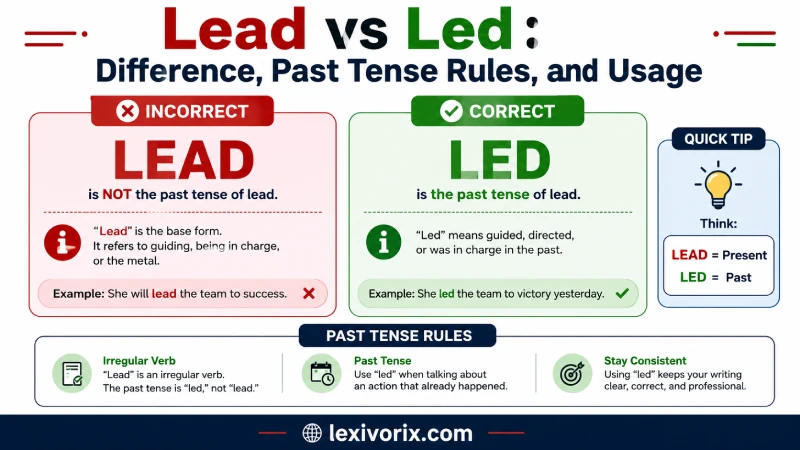
Choosing between lead and led is one of the most frequent spelling and grammar challenges in modern English. Both words appear constantly in business emails, academic papers, news reporting, and resumes. Because they are closely related and share overlapping pronunciations, even experienced writers occasionally type the wrong one.
The confusion usually arises because the word “lead” changes its pronunciation and meaning depending on how it is used. When you add the heavy metal element “lead” into the mix—which is spelled like the present-tense verb but pronounced like the past-tense verb—it becomes easy to see why slip-ups happen.
Mastering the difference between lead and led requires looking at verb tense and sentence timing. Once you learn a few simple memory shortcuts and recognize how these words function, you will never second-guess your choice again.
Quick Answer
The difference between lead and led comes down to timing and part of speech:
- Lead (pronounced /leed/, rhymes with seed) is a present-tense and future-tense verb meaning to guide, direct, or command.
- Led (pronounced /led/, rhymes with red) is the past-tense and past-participle form of that same verb.
- Lead (pronounced /led/, rhymes with red) can also be a noun referring to the soft, heavy metal element (Pb) or pencil graphite.
To pick the correct verb in a flash, use the Guided Test:
Replace the word in your sentence with “guided.” If “guided” makes sense, the correct spelling is always led.
- “Today, I lead the team.” (Present action)
- “Yesterday, I led the team.” (Past action — I guided the team)
Why People Confuse Them
Understanding why this spelling mistake happens makes it much easier to avoid. English has a few structural quirks that trick our brains when writing these two words.
The “Read/Read” Trap
In English grammar, many verbs maintain the exact same spelling in both the present and past tenses even when their pronunciation changes. The most famous example is the verb read:
- Present tense: “I read (/reed/) the news today.”
- Past tense: “Yesterday, I read (/red/) the news.”
Because “read” keeps its four-letter spelling in the past tense while changing its vowel sound, many writers assume that “lead” follows the identical pattern. They write “Yesterday I lead the project,” thinking that “lead” changes pronunciation to /led/ while keeping the same letters. However, “lead” does not follow this pattern. Its past tense drops the letter a entirely to become led.
The Metal Noun Homophone
Another major source of confusion is the noun lead (the heavy metallic element, chemical symbol Pb). This noun is spelled lead but is pronounced identically to led (/led/).
When writers hear the sound /led/ in their minds while drafting a sentence about past events, their brain retrieves the spelling “lead” from the metal noun. This phonetic overlap causes people to accidentally write “The trail lead us to the river” instead of “The trail led us to the river.”
Automated Grammar Checker Limitations
Most digital writing assistants and basic spellcheckers struggle to catch this error. Because both “lead” and “led” are valid English words, typing “She lead the meeting yesterday” often slips past simple spellcheckers. The software recognizes “lead” as a real word and fails to spot the tense inconsistency.
Key Differences At A Glance
Use this reference table to identify the right choice based on the context of your sentence:
| Context | Best Choice | Why |
| Present or future action of guiding | lead | “Lead” (rhymes with seed) is the present and future tense verb |
| Past action of guiding or conducting | led | “Led” (rhymes with red) is the past tense and past participle verb |
| Action that caused a past result | led | Past results use the past-tense construction “led to” |
| Referring to the heavy metal element | lead | The noun for the metal is spelled “lead” (pronounced /led/) |
| Position of advantage in a game or race | lead | The noun for a head position is spelled “lead” (pronounced /leed/) |
| Clue or piece of information in an investigation | lead | The noun for a hint or clue is spelled “lead” (pronounced /leed/) |
| Light-emitting diode acronym | LED | Capitalized three-letter acronym for electronic lighting |
Meaning and Usage Difference
To use lead and led with complete accuracy, it helps to examine their specific roles across sentence structures and grammatical forms.
The Verb Forms: Tense and Timing
When operating as verbs, these two words represent different points on a timeline.
Lead (Present, Future, Infinitive):
- Present Tense: “She leads the engineering division with great vision.”
- Future Tense: “Tomorrow, our captain will lead us onto the field.”
- Infinitive Form: “It takes courage to lead during a crisis.”
Led (Past Tense and Past Participle):
- Simple Past Tense: “Last year, he led the company through a major merger.”
- Past Participle: “Having led multiple campaigns, she understood the strategy.”
- Passive Voice: “The parade was led by the high school marching band.”
The Noun Forms of “Lead”
Unlike “led” (which functions strictly as a verb), “lead” wears many hats as a noun. It carries two distinct pronunciations depending on its meaning:
- Pronounced /leed/ (rhymes with seed):
- Front Position / Advantage: “Our team took the lead in the fourth quarter.”
- Information / Clue: “Detectives are following a fresh lead in the case.”
- Principal Role: “She landed the female lead in the Broadway musical.”
- Restraint for Animals: “Keep your dog on a lead while in the park.”
- Pronounced /led/ (rhymes with red):
- Heavy Metal Element: “Old homes often have pipes made of lead.”
- Pencil Core: “I need to buy more lead for my mechanical pencil.” (Note: Pencil cores are actually made of graphite, but are colloquially called lead.)
Summary Feature Comparison
| Feature | lead | led |
| Primary Parts of Speech | Verb, Noun, Adjective | Verb (strictly) |
| Verb Tense Role | Present, Future, Infinitive | Simple Past, Past Participle |
| Pronunciation 1 | /leed/ (verbs, advantages, clues) | /led/ (past tense verb) |
| Pronunciation 2 | /led/ (heavy metal element) | N/A |
| Rhyme Helper | Rhymes with seed or red | Rhymes with red or bed |
| Direct Synonym | Guide, direct, command | Guided, directed, commanded |
Tone, Context, and Formality
While grammatical errors are frustrating in any setting, confusing lead and led carries different consequences depending on where it occurs.
Resumes and Professional Bios
Resume bullet points almost always describe past accomplishments. Action verbs on a resume must sit in the simple past tense.
Writing “Lead a team of six developers to launch a mobile app” is a noticeable grammatical error on a job application. Because HR recruiters and hiring managers scan resumes quickly, using “lead” instead of led suggests a lack of attention to detail.
- Incorrect: “Lead a cross-functional marketing team that increased sales by 20%.”
- Correct: “Led a cross-functional marketing team that increased sales by 20%.”
Academic and Historical Writing
In research papers and historical analysis, writers frequently discuss cause-and-effect relationships that took place in the past. The phrase “led to” is standard in these contexts.
- Incorrect: “The economic policies of the 1920s lead to the stock market crash.”
- Correct: “The economic policies of the 1920s led to the stock market crash.”
Media and Journalism
In journalism, headlines often use present tense for immediacy (“President Leads Conference in Geneva”), but the body of the article switches to past tense to describe events that already happened (“Yesterday, the President led discussions on climate policy”). Keeping this distinction clean ensures news copy remains crisp and professional.
Which One Should You Use?
When drafting content, rely on these two simple mental tests to select the correct word every time.
Test 1: The “Guided” Substitution Test
Whenever you are unsure whether to write “lead” or “led” as a verb, swap the word with guided or directed:
- Sentence: “She [lead / led] the committee through the new guidelines.”
- Test: “She guided the committee through the new guidelines.”
- Result: Because “guided” works naturally in the sentence, the correct choice is led.
If the sentence requires guides or will guide, then use lead:
- Sentence: “She will [lead / led] the committee tomorrow.”
- Test: “She will guide the committee tomorrow.”
- Result: Because “guide” fits, the correct choice is lead.
Test 2: The Timeline Test
Ask yourself when the action takes place:
- Is it happening now or in the future? Use lead (rhymes with seed).
- “I lead this department.” / “I will lead the project.”
- Did it already happen? Use led (rhymes with bed).
- “I led this department last year.” / “I led the project to completion.”
When One Choice Sounds Wrong
Reading sentences with mismatched tenses helps train your visual memory to spot errors instantly.
Incorrect Past Tense Construction
Incorrect: “The tour guide lead us through the historic district yesterday.”
Why it fails: “Yesterday” establishes that the action occurred in the past. “Lead” in the past tense creates a visual error, even if the writer pronounced it as /led/ while reading aloud.
Correct: “The tour guide led us through the historic district yesterday.”
Incorrect Present Tense Construction
Incorrect: “If you take charge, you can led the group to success.”
Why it fails: The modal verb “can” requires an infinitive verb form. “Led” is strictly a past-tense form and cannot follow “can.”
Correct: “If you take charge, you can lead the group to success.”
Confusing the Metal Noun with the Verb
Incorrect: “Exposure to led can cause health issues in young children.”
Why it fails: “Led” is exclusively a verb form. The heavy metal element must always be spelled “lead.”
Correct: “Exposure to lead can cause health issues in young children.”
Common Mistakes (and Quick Fixes)
Review these common error patterns to fix frequent writing slip-ups:
- Error: Misspelling past tense in performance reviews
- Wrong: “Marcus lead the sales team to record profits last quarter.”
- Fix: “Marcus led the sales team to record profits last quarter.”
- Error: Incorrect cause-and-effect phrasing
- Wrong: “Poor communication lead to missed deadlines on the last launch.”
- Fix: “Poor communication led to missed deadlines on the last launch.”
- Error: Using past tense after “to” (infinitive error)
- Wrong: “She was appointed to led the research division.”
- Fix: “She was appointed to lead the research division.”
- Error: Mixing up pencil terminology
- Wrong: “I need more led for my mechanical pencil.”
- Fix: “I need more lead for my mechanical pencil.”
Everyday Examples
Here is how lead and led function correctly across business, academic, news, and casual settings:
Business and Corporate Writing
- “Our CEO will lead the quarterly earnings call this afternoon.”
- “The project manager led a successful audit of our security protocols last week.”
- “Strong corporate governance can lead to improved investor confidence.”
Academic and Historical Contexts
- “Historical evidence shows that trade routes led to cultural exchanges across continents.”
- “Researchers hope this discovery will lead to improved treatments for the disease.”
- “Dr. Vance led the clinical trial from 2021 through 2024.”
News, Sports, and Casual Speech
- “The quarterback led his team on a 90-yard game-winning drive.”
- “The marathon runner expanded her lead as she entered the final mile.”
- “Can you lead the way to the conference room?”
Dictionary-Style Word Details
Verb
lead
- Definition: To show the way by going in advance; to conduct, guide, or direct; to hold first place in a competition or group.
- Pronunciation: /leed/ (rhymes with seed).
- Tense: Present tense, future tense, infinitive.
- Forms: lead, leads, leading.
led
- Definition: Guided, directed, commanded, or brought about as a result (past form of lead).
- Pronunciation: /led/ (rhymes with red).
- Tense: Simple past tense, past participle.
- Forms: led (does not take -ed suffixes).
Noun
lead
- Definition 1 (/leed/): The front position or distance ahead in a race; a helpful clue or hint in an investigation; the main role in a play or film; a dog leash.
- Definition 2 (/led/): A soft, heavy, ductile metallic element (symbol Pb, atomic number 82); graphite used in pencils.
led
- Status: Does not function as a standard lower-case noun in English.
- Capitalized Exception: LED (all capitals) is an acronym standing for “Light-Emitting Diode,” referring to semiconductor light sources used in electronic displays and light bulbs.
Synonyms
lead
- Verb Synonyms (Present): Guide, direct, steer, conduct, pilot, head, govern, command.
- Noun Synonyms (/leed/): Advantage, edge, head start, clue, hint, leash, starring role.
- Noun Synonyms (/led/): Plumbum (chemical term for lead metal), graphite core.
led
- Past Verb Alternatives (Closest Plain Alternatives): Guided, directed, steered, conducted, piloted, headed, governed, commanded, resulted in, brought about.
- Antonyms: Followed, trailed, yielded, submitted (when describing past actions).
Example Sentences
lead
- “Inspirational managers lead by example rather than by mandate.”
- “The team managed to build a commanding ten-point lead before halftime.”
- “Investigators received an anonymous tip that gave them a promising new lead.”
- “Before painting old furniture, test the surface to ensure it does not contain lead.”
led
- “The search-and-rescue team led the stranded hikers back to camp safely.”
- “Decisive leadership during the market shift led the company to record growth.”
- “The trail led through dense forest before opening onto a scenic mountain overlook.”
- “Having led similar initiatives in the past, she handled the reorganization effortlessly.”
Word History
lead
The verb lead originates from the Old English verb lǣdan, which meant “to cause to go with oneself, guide, or conduct.” It derives from the Proto-Germanic laidijaną (to lead or go). Over centuries, the basic spelling lead remained stable in English orthography for the present tense form.
led
The past-tense form led stems from the Old English past-tense form lǣdde. During the Middle English period, as English spelling became more standardized alongside changes in vowel pronunciation (the Great Vowel Shift), the spelling shifted from ladde or lede to led. This change reflected the shortening of the vowel sound from a long /e:/ sound to the short /ɛ/ sound heard in “bed” and “red.”
Phrases Containing
lead
- Lead by example: To demonstrate desired behavior through one’s own actions.
- Take the lead: To assume control or move into the front position.
- Lead down the garden path: To deceive or mislead someone.
- Lead the pack: To be at the forefront of a group or market competition.
led
- Led to believe: Induced to accept something as true based on evidence or statements.
- Led by the nose: Controlled or manipulated completely by someone else.
- Led astray: Guided away from proper behavior, truth, or correct paths.
FAQs
The past tense of the verb “lead” is always spelled led (rhymes with red). Writing “lead” as the past tense is a common spelling mistake.
English verb origins vary. “Read” kept its four-letter spelling in both tenses (read / read) due to Middle English spelling conventions. “Lead” shortened its spelling in the past tense to led to reflect its short vowel sound /led/.
It depends on the timing of the sentence:
Use led by for past actions: “The project was led by Sarah.”
Use lead by for present or infinitive actions: “Managers should lead by example.”
Yes, “leaded” is an adjective or verb form, but it refers specifically to the metal element lead (e.g., “leaded gasoline” or “leaded glass windows”). It is never used as the past tense for guiding or directing.
Use led to for past events (“The decision led to unexpected consequences”). Use lead to for present or future possibilities (“Poor planning can lead to failure”).
Conclusion
Distinguishing between lead vs led is simple when you focus on verb tense and timing. Use lead (rhymes with seed) when describing present or future actions of guiding, or when referring to a front position, clue, or heavy metal. Use led (rhymes with red) whenever you describe an action of guiding or resulting in something that already happened in the past.
Whenever you feel uncertain while drafting, apply the Guided Test: if “guided” fits the sentence, the correct word is always led. With this rule in mind, your writing will remain clear, precise, and professional.


