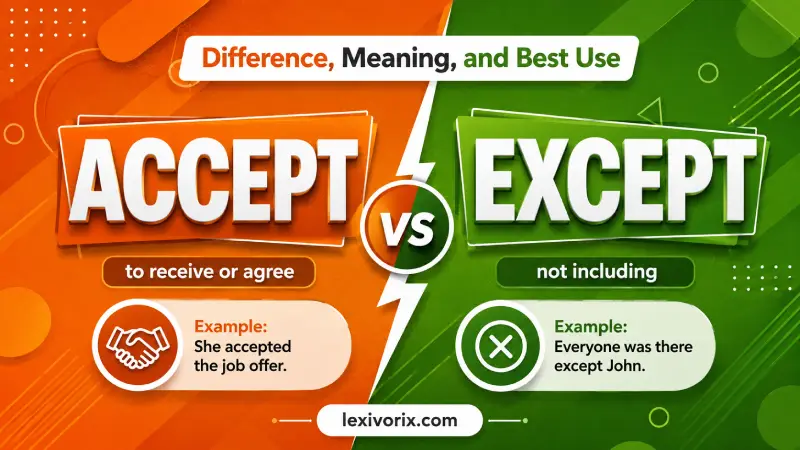
Accept vs except is a common word-choice problem because the two words look similar and often sound alike. However, they do not mean the same thing.
Use accept when someone receives, agrees to, approves, or admits something. By contrast, use except when someone or something is left out.
That small spelling difference can change the entire meaning of a sentence. For example, “I accept your apology” means you receive or acknowledge the apology. On the other hand, “I except your apology” does not work in normal everyday English.
Therefore, the easiest way to remember the difference is this: accept takes something in; except leaves something out.
Quick Answer
Accept is correct when the meaning is receive, agree to, approve, or admit as true.
Example:
I accept your offer.
Except is correct when the meaning is not including, excluding, or other than.
Example:
Everyone except Noah joined the meeting.
In short, the words are not interchangeable. So, choose the word based on meaning, not sound.
Why People Confuse Them
People confuse accept and except for a few simple reasons.
First, the spelling differs by only one letter. As a result, the words can look almost the same when you read quickly.
Second, they sound alike or nearly alike in many accents. Because of that, hearing the word does not always help you spell it correctly.
Finally, both words appear often in school, work, emails, forms, policies, and everyday messages. Even so, their meanings stay completely different.
Accept points to agreement or receiving. Except, however, points to exclusion.
Key Differences At A Glance
| Context | Best Choice | Why |
|---|---|---|
| Saying yes to an offer | Accept | You agree to take it |
| Receiving a gift or delivery | Accept | You take what is offered |
| Admitting something is true | Accept | You acknowledge it |
| Taking responsibility | Accept | You own the action or result |
| Leaving someone out of a group | Except | You mean “not including” |
| Naming an item excluded from a rule | Except | You show an exception |
| Using “other than” in a sentence | Except | You are excluding something |
| Introducing a limiting idea | Except | You show a condition or exception |
A compact way to compare them:
- Accept means to take in.
- Except means to leave out.
- Accept is a verb.
- Except is usually a preposition or conjunction.
- Except can also be a formal verb, although that use is less common.
- Accept fits offers, apologies, payments, invitations, truth, and responsibility.
- Except fits rules, groups, lists, schedules, and exclusions.
Meaning and Usage Difference
Accept is a verb. It shows that someone receives, agrees to, approves, or recognizes something.
For example, you can accept a job offer. You can also accept an apology, accept a package, accept responsibility, or accept the truth.
Examples:
I accept the new schedule.
She accepted the invitation.
We accept credit cards.
He accepted responsibility for the delay.
In each sentence, someone takes in an offer, idea, fact, item, or duty.
Except, however, works differently. It usually shows that someone or something is not included.
Examples:
Everyone except Daniel arrived on time.
The store is open every day except Sunday.
I finished every assignment except the final essay.
The rule applies to all employees except contractors.
In each case, except points to what is left out.
Additionally, except can introduce a limiting clause.
Example:
I would go with you, except I have to work late.
Here, except means something close to “but” or “only that.” It explains why the first idea cannot happen.
Although except can also be a verb meaning “to leave out,” that use sounds formal.
Example:
Children under five were excepted from the fee.
Even though this sentence is correct, most everyday writers would use excluded instead.
Tone, Context, and Formality
Both accept and except are standard English words. Therefore, you can use them in casual writing, school writing, business writing, and formal writing.
However, the tone depends on the sentence.
Accept sounds natural in everyday situations:
I accept your apology.
They accepted my application.
We accept debit cards.
It also works well in formal writing:
The board accepted the proposal.
The company accepted the revised terms.
Meanwhile, except sounds natural when you discuss rules, groups, limits, or schedules:
Everyone except Mia replied.
The gym is open daily except major holidays.
All returns are allowed except final-sale items.
However, the verb form excepted sounds more formal:
The first group was excepted from the requirement.
For clearer everyday writing, you may prefer:
The first group did not have to meet the requirement.
So, in most normal sentences, use except when you mean “not including.”
Which One Should You Use?
Choose accept when the sentence involves saying yes, receiving something, approving something, or admitting something is true.
Examples:
Please accept my apology.
I accepted the job offer.
The school accepted her application.
We accept online payments.
He finally accepted that he was wrong.
Choose except when the sentence leaves someone or something out.
Examples:
Everyone except Chris signed the card.
The office is closed on all federal holidays except Veterans Day.
I like every flavor except coconut.
She read every chapter except the last one.
A simple test can help.
If receive, agree to, or approve fits, use accept.
If excluding, other than, or not including fits, use except.
For example:
I will ___ the offer.
Because you can say “I will agree to the offer,” the correct word is accept.
Everyone ___ Liam was ready.
Because you can say “Everyone other than Liam was ready,” the correct word is except.
When One Choice Sounds Wrong
The wrong word often makes the sentence sound strange right away.
Wrong: I except your apology.
Right: I accept your apology.
The sentence needs a word that means “receive” or “acknowledge.” Therefore, accept is correct.
Wrong: Everyone accept Grace finished the project.
Right: Everyone except Grace finished the project.
Because Grace is left out of the group, except is correct.
Wrong: We except all major credit cards.
Right: We accept all major credit cards.
A business receives or allows credit cards. So, accept is the right choice.
Wrong: The sale includes everything accept furniture.
Right: The sale includes everything except furniture.
Since furniture is not included, except fits.
Common Mistakes And Quick Fixes
Mistake 1: Using accept when you mean “excluding.”
Wrong: Everyone accept the new intern attended lunch.
Right: Everyone except the new intern attended lunch.
Quick fix: If you can replace the word with “other than,” use except.
Mistake 2: Using except when you mean “agree to.”
Wrong: She excepted the offer on Monday.
Right: She accepted the offer on Monday.
Quick fix: If someone says yes, use accept.
Mistake 3: Using except for payments or apologies.
Wrong: We except debit cards.
Right: We accept debit cards.
Wrong: Please except my apology.
Right: Please accept my apology.
Quick fix: If something is received, allowed, or acknowledged, use accept.
Mistake 4: Using accept before an excluded day, person, or item.
Wrong: The pool is open every day accept Tuesday.
Right: The pool is open every day except Tuesday.
Quick fix: If one item is left out, use except.
Mistake 5: Thinking except always needs “for.”
Both forms can be correct.
Correct: Everyone except Ava came to class.
Correct: The room was empty except for one backpack.
In many cases, except for sounds natural before a noun phrase. Still, except alone can also be correct.
Everyday Examples
Work:
I accept the updated deadline.
Everyone except the design team joined the call.
School:
The teacher accepted late work until Friday.
Every student except Marcus turned in the form.
Email:
Please accept my thanks for your help.
I am free every afternoon except Thursday.
Shopping:
The store accepts returns within 30 days.
All items are returnable except clearance items.
Family:
My parents accepted our dinner invitation.
Everyone except my cousin wanted pizza.
Travel:
The hotel accepts most major cards.
The shuttle runs daily except Sunday.
Rules:
The coach accepted the referee’s decision.
Players may use the field except during maintenance.
Apology:
I accept your apology.
I forgive everyone involved except the person who lied.
You can also use both words in one sentence:
I accept every part of the plan except the budget.
In that sentence, accept means “agree to,” while except means “excluding.”
Dictionary-Style Word Details
Verb
- Accept:
Accept is a verb. It means to receive, agree to, approve, allow, or recognize something as true.
Examples:
I accept the offer.
They accepted the package.
She accepted responsibility.
We accept your explanation.
- Except:
Except can be a verb, but this use is less common and more formal. As a verb, it means to leave out or exclude.
Examples:
The policy excepted employees hired before 2020.
Students with medical notes were excepted from the rule.
In everyday writing, excluded often sounds clearer than excepted.
Noun
- Accept:
Accept is not commonly used as a noun. The related noun is acceptance, but that is a different word.
Example:
Her acceptance of the offer came by email.
- Except:
Except is not commonly used as a noun. The related noun is exception, but that is also a different word.
Example:
There was one exception to the rule.
Therefore, for the exact words accept and except, the noun category does not commonly apply.
Synonyms
- Accept:
Closest plain alternatives include receive, agree to, approve, allow, acknowledge, admit, and take on.
Examples:
Accept an offer = agree to an offer.
Accept a package = receive a package.
Accept responsibility = take responsibility.
Accept the truth = acknowledge the truth.
Helpful opposites include reject, refuse, and deny, depending on the sentence.
- Except:
Closest plain alternatives include excluding, other than, apart from, not including, and sometimes unless.
Examples:
Everyone except Leo = everyone other than Leo.
Open daily except Monday = open daily, not including Monday.
I would go, except I am sick = I would go, but I am sick.
However, do not treat except as a synonym for reject. That mistake leads to incorrect sentences.
Example Sentences
- Accept:
I accept your answer.
She accepted the scholarship.
They accepted our reservation.
We accept cash, cards, and mobile payments.
He accepted that the plan needed more work.
- Except:
Everyone except Ben voted yes.
The library is open every day except Sunday.
I finished every task except the budget report.
The policy covers all repairs except accidental damage.
I would join you, except I already have plans.
- Both Words Together:
I accept all of the changes except the last one.
We accept returns except on final-sale items.
She accepted every invitation except the one for Friday night.
Word History
- Accept:
Accept comes through older French and Latin roots connected with taking or receiving. That history matches the modern meaning: to take in, receive, or agree to something. - Except:
Except also comes through older French and Latin roots, but it connects with taking out or leaving out. That history matches the modern meaning: to exclude.
Still, you do not need word history to choose correctly. The modern rule is enough: accept takes in; except leaves out.
Phrases Containing
- Accept:
Accept an offer
Accept an invitation
Accept an apology
Accept responsibility
Accept payment
Accept the truth
Accept the terms
Widely accepted
Generally accepted
Accepted practice
Examples:
Please accept our invitation.
The store accepts payment by card.
That explanation is widely accepted.
- Except:
Except for
Except that
Except when
Except in emergencies
Everyone except
All except
Nothing except
Present company excepted
Examples:
The plan works except for one issue.
I would help, except that I am out of town.
No parking is allowed except in emergencies.
Everyone agreed, present company excepted.
Some phrases with except sound formal. Therefore, use them only when they fit the tone.
FAQs
Accept means to receive, agree to, approve, or admit something. Except means to leave something out or show that something is not included.
Example:
I accept the rule except the final part.
he correct word is accept.
Write:
Please accept my apology.
An apology is something someone receives or acknowledges. Therefore, except does not fit.
The correct word is except.
Write:
Everyone except me was invited.
The sentence means everyone was invited other than me
Yes, except can be a verb. However, that use is formal and less common.
Example:
Some employees were excepted from the rule.
In everyday writing, excluded often sounds more natural.
They often sound alike or nearly alike in everyday speech. However, some speakers pronounce the first syllable slightly differently.
In writing, meaning matters more than pronunciation.
Use this memory line:
Accept takes in. Except leaves out.
Also, except starts with ex, like exclude. That can help you remember that except points to what is not included.
Yes. In fact, using both words together can make the difference clear.
Example:
I accept every suggestion except the last one.
Here, accept means “agree to,” and except means “excluding.”
The most common mistake is using accept when the sentence means “not including.”
Wrong:
Everyone accept Riley came to practice.
Right:
Everyone except Riley came to practice.
Conclusion
The difference between accept vs except becomes simple once you focus on meaning.
Use accept when someone receives, agrees to, approves, or admits something. However, use except when someone or something is left out.
So, remember the final rule: accept takes in; except leaves out.


